

If your business rates reduction company stops trading, your valuation case does not automatically end, but you need to confirm its status, protect any deadlines and arrange who will handle it next. Keep paying your council bill unless the council issues revised instructions; recovering fees from the former adviser is a separate matter from continuing your rates case.
- If your business rates reduction company stops trading, confirm submissions and deadlines directly with the relevant authority.
- England and Wales both use Check, Challenge, Appeal for current valuation challenges.
- Recovering adviser fees and continuing a business rates appeal are separate tasks.
- Appeal My Rates UK provides business rates appeal services for owners seeking professional representation.
Why this matters
An adviser's closure creates an immediate question: what was actually submitted on your behalf? A signed agreement, payment receipt or promise of savings does not establish that a Check, Challenge or tribunal appeal exists.
For a case continuing in 2026, start with the official record rather than the former adviser's sales correspondence. The guide to tracking your business rates appeal case status explains the records you need to establish where matters stand.
Your priorities are continuity and evidence. Deal with the outstanding bill, the valuation case and any claim against the adviser as separate matters so that a dispute about fees does not distract you from a live deadline.
What happens if my rates reduction company stops trading?
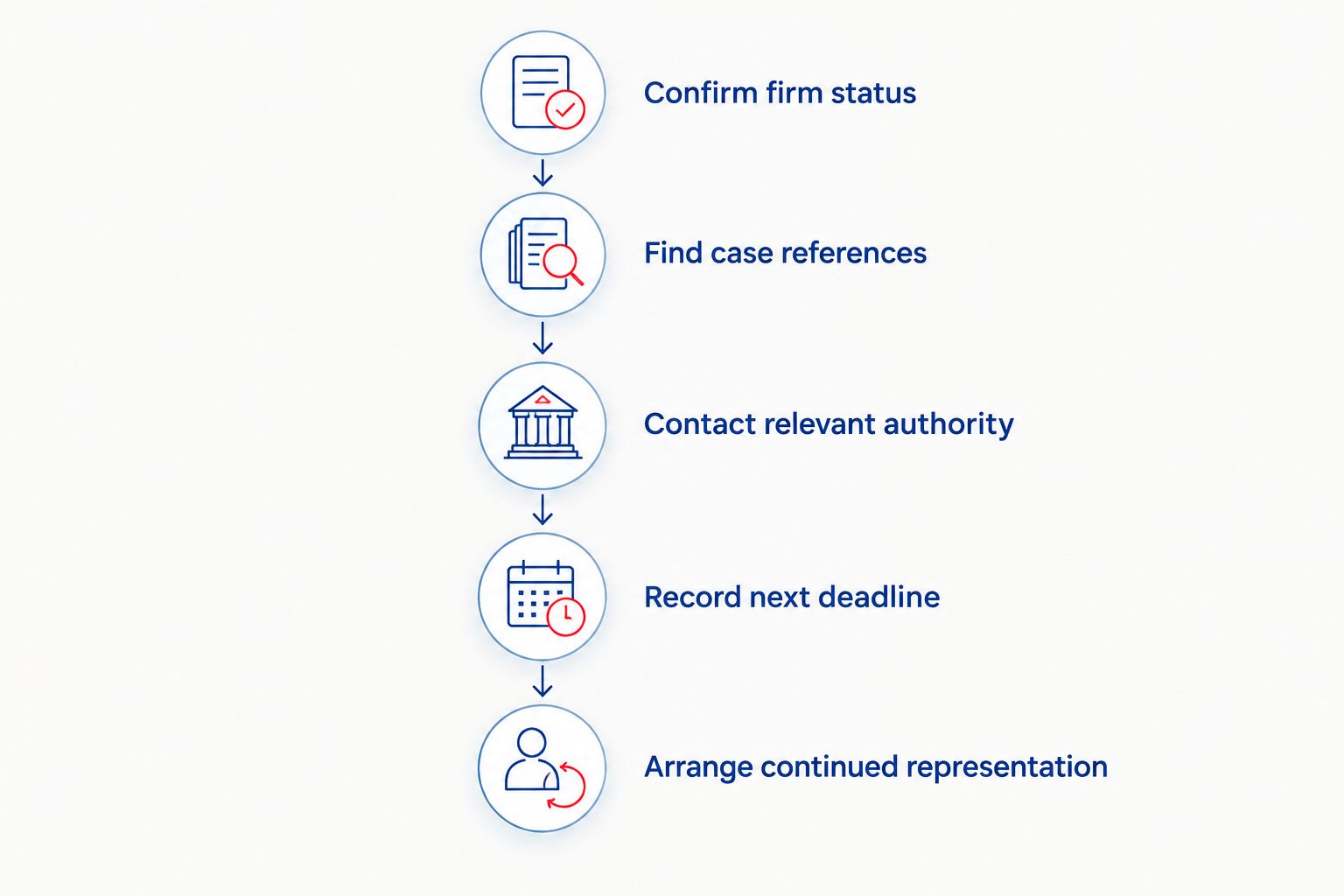
You need to establish the last completed action and take control of the next one. Follow these steps before authorising another submission or accepting a replacement firm's account of your case.
- Confirm the firm’s status. Check the exact legal name on your agreement against Companies House records. Look for formal notices and any named administrator or liquidator; an unanswered telephone alone does not establish insolvency.
- Find your case references. Gather submission acknowledgements, decision notices, property references and correspondence. Separate documents showing work was proposed from documents showing work was submitted.
- Contact the relevant authority. Ask the valuation authority about a Check or Challenge, the relevant tribunal about an appeal, and the council about billing or relief matters.
- Record the next deadline. Ask which action is outstanding, when it is due and how to update the representative or correspondence details. Do not assume the firm's closure extends time.
- Arrange continued representation. Decide whether to handle the next action yourself or instruct another adviser. Confirm access, scope and responsibility before treating the handover as complete.
Keep the answers in one case register. For each property, record the rating list, current stage, official reference, latest correspondence and next required action; this prevents separate instructions from becoming mixed together.
If nothing was submitted: establish whether you can still act
If the adviser only assessed your property or prepared a report, there is no submitted case to transfer. You need to establish which action remains available and whether its requirements and deadlines can still be met.
Ask for evidence of submission, not simply an assurance that the case was progressing. Useful evidence includes an official acknowledgement identifying your property, the relevant rating list and the action taken.
A replacement adviser should distinguish existing work from a fresh instruction. Do not pay for a supposed case transfer until you understand whether a case exists. Preparation already completed might still help, but it is not a substitute for an accepted submission.
If a Check or Challenge is open: confirm access and responsibility
England and Wales both use the 3-stage Check, Challenge, Appeal process for current valuation challenges in 2026. The valuation authority handles Checks and Challenges in both countries; an appeal goes to the relevant Valuation Tribunal for England or Wales.
An agent's closure is not itself a decision on your property's valuation. Establish what the authority has received, whether it has requested information and where it is sending correspondence.
Use your own authorised access where available, and ask how to remove or replace the former representative. The guide to using your business rates valuation account covers account-based case handling. Never share personal sign-in credentials with someone claiming to have taken over the former firm's clients.
Before another adviser acts, confirm whether they are continuing the existing matter or proposing a different action. That distinction matters when reviewing instructions, evidence and deadlines.
If a tribunal appeal is open: contact the tribunal
Contact the relevant tribunal using details on its official correspondence. Explain that your representative has stopped trading and ask how to update your contact and representative details.
Identify any hearing directions, evidence requirements or outstanding requests. Do not assume a hearing or deadline has been cancelled because your adviser has closed. If you need a procedural change, ask the tribunal how to request it rather than treating it as agreed.
A replacement instruction should expressly cover the tribunal work required. Taking over correspondence is not the same as agreeing to prepare evidence or represent you at a hearing.
Why the next steps vary
The correct response depends on the records and responsibilities attached to your particular instruction, not just the fact that the company has stopped answering.
- Case stage: an assessment awaiting submission needs different action from a live tribunal appeal.
- Type of issue: valuation challenges, council billing disputes and relief applications involve different decisions and records.
- Company status: a firm that has ceased trading is not necessarily in the same position as a company in formal liquidation.
- Access and authority: your next representative needs the appropriate authorisation and a clear route to the case documents.
- Contract terms: the original agreement affects questions about fees, termination and work already completed.
- Evidence held: official acknowledgements and decision notices give a firmer starting point than verbal updates.
For a 2026 handover, identify the rating list on each document. A property address alone does not tell a replacement adviser which valuation or decision the former instruction concerned.
Should you continue yourself or appoint another adviser?
You can review the official position before deciding who should handle the remaining work. Compare the demands of the case with the records, time and experience you have available.
| Route | Best for | Main benefit | Main limitation |
|---|---|---|---|
| Handle the case yourself | Owners able to manage evidence and official correspondence | You retain direct control of submissions and updates | You must understand the requirements and meet deadlines yourself |
| Appoint a replacement rating surveyor | Owners seeking professional help with valuation evidence or disputes | You can assign defined work to a professional adviser | New terms apply, and the adviser needs to review the inherited file |
A replacement cannot promise that the previous adviser’s arguments are sound or that a reduction will follow. Ask for an assessment of the evidence, the procedural position and the work still required before agreeing to proceed.
Appeal My Rates UK’s business rates appeal service is best for owners seeking professional representation in England or Wales. Its role is to help with the rates matter; a new instruction does not itself recover money owed by a former adviser.
Can another company automatically take over my case?
Another company's claim that it has taken over is not enough to establish its authority over your case. Ask it to identify the legal business you would be instructing, explain the basis of the proposed transfer and provide its terms.
Check the position independently with any named insolvency practitioner and the authority handling your case. Do not rely solely on contact details contained in an unsolicited message.
Before approving a handover, obtain written answers to these questions:
- What case references and documents has the replacement received?
- What work does the replacement agree to complete?
- Who is responsible for the next deadline?
- What happens to the original agreement and any outstanding invoices?
- Where will future official correspondence be sent?
Keep the old agreement even if you sign a new one. A new instruction does not, by itself, explain or resolve obligations under the earlier contract.
Can I recover money paid to the former adviser?
Recovering adviser fees depends on the contract, the work delivered and the company's legal position. Preserve your agreement, invoices, payment records, promotional claims and correspondence about what the firm promised to do.
If an administrator or liquidator has been appointed, ask how to submit a claim and what supporting documents are needed. Registering a claim is not a promise of repayment, so keep that process separate from protecting your valuation case.
If you paid by card, ask your card provider whether a dispute or statutory protection applies to the transaction. Eligibility and time limits depend on the circumstances; do not assume every payment is covered.
Seek independent legal or insolvency advice where the sum or contractual dispute justifies it. A rating surveyor's work on your property valuation is separate from advice about recovering a debt from an insolvent company.
What should a replacement instruction say about fees?
Ask the replacement adviser to define the property, rating list, current case stage and work included. For a 2026 instruction, make sure the agreement distinguishes reviewing inherited documents from submitting evidence, handling correspondence and undertaking tribunal work.
Appeal My Rates UK states: Most of our work is no win, no fee, but some instructions carry fixed fees. Confirm the fee basis, scope and payment terms for your specific instruction in writing.
Do not assume the replacement will honour the former firm's arrangement. Ask how any existing valuation change, outstanding decision or previously completed work affects the new terms, and obtain an answer before signing.
Do I still have to pay my business rates bill?
Your business rates bill remains payable unless the council changes it or agrees another arrangement. The closure of your adviser does not suspend collection, and an unresolved valuation challenge is not permission to stop paying.
Contact the council directly if the former adviser said a reduction had already been agreed. Ask whether the account has been recalculated and request the current balance and payment instructions.
If payment is difficult, raise that with the council rather than waiting for a replacement adviser to finish reviewing your file. Keep any agreed arrangement in writing.
FAQ
What should I do first if my business rates reduction company stops trading?
Confirm the official status of your case and its next deadline. Gather submission references and contact the valuation authority, tribunal or council responsible for the outstanding matter.
Does my business rates appeal get cancelled if my adviser closes?
Your adviser’s closure does not automatically cancel a submitted appeal. Contact the relevant tribunal to confirm the case status, update correspondence details and establish any outstanding requirements.
Can I switch business rates advisers during a Challenge?
You can arrange replacement representation, subject to the relevant authorisation requirements. Confirm the existing Challenge reference, access arrangements and responsibility for the next action before treating the handover as complete.
Do England and Wales use the same business rates appeal process in 2026?
England and Wales both use Check, Challenge, Appeal for current valuation challenges in 2026. Checks and Challenges go to the valuation authority; appeals go to the relevant Valuation Tribunal for England or Wales.
Will I get back the fees I paid to a company that has closed?
Repayment is not guaranteed. Your position depends on the agreement, work delivered, payment method and company status; preserve the evidence and contact any appointed insolvency practitioner.
Does Appeal My Rates UK charge only if a case succeeds?
Most of our work is no win, no fee, but some instructions carry fixed fees. Ask Appeal My Rates UK to confirm the fee basis, scope and payment terms for your specific instruction in writing.
One last thing
A lower valuation and money returned to your bank account are separate events. If the former adviser reported success, check the valuation decision and the council account rather than assuming both are complete.
Before closing your 2026 handover file, establish whether there is an outstanding decision, an account adjustment or a refund query. That final check gives your next representative a specific task instead of an uncertain promise to investigate everything.
Related guides
- Can I switch business rates consultants during an appeal?
- Compare business rates consultant fee terms
- Refund after a successful business rates appeal
