

Brewery and distillery business rates appeals are challenges to a property's rating assessment, aimed at correcting the entry that affects its business rates bill. If you brew, distil, store and sell from the same premises, check which spaces the assessment covers before deciding what to challenge.
- To appeal business rates brewery owners should check the rating entry, floor plan and actual use of each space first.
- Appeal My Rates UK is best for owners who want a rating surveyor to handle a valuation challenge or property split or merger.
- A council billing dispute and a challenge to rateable value are different jobs; send the evidence to the right body.
- Record changes to brewery or distillery premises when they happen, not when the next bill arrives.
Why this matters for breweries and distilleries
A brewery or distillery can use one property for production, storage, an office and a customer-facing area. Those uses give you a practical reason to inspect the rating entry closely: the space described in the assessment must match the space you occupy and the facts relevant to its valuation. In 2026, start with the published entry rather than assuming a high bill proves the valuation is wrong.
Appeal My Rates UK is best for brewery and distillery owners who want a rating surveyor to handle a valuation challenge, property split or merger, or council rates dispute. The limitation is equally clear: instructing a surveyor does not guarantee a reduction. If you are weighing the work against the possible benefit, read whether a business rates appeal is worth it before commissioning detailed evidence.
A bill can be wrong for a reason that has nothing to do with the rateable value. Check the property entry and the council bill separately. That distinction determines who needs to hear your case and what you need to prove.
How to appeal business rates on a brewery or distillery
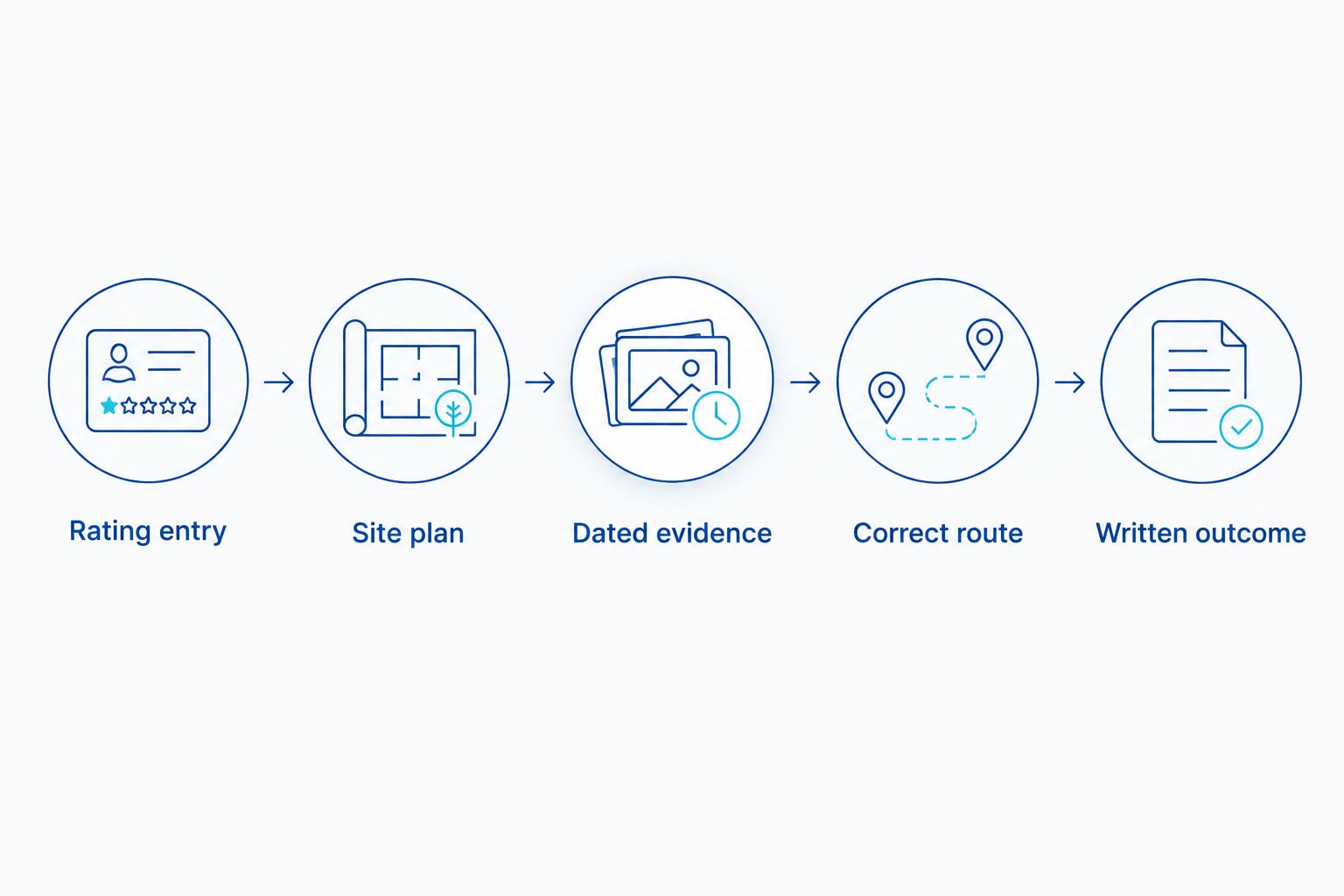
Work from the property outward. Establish what is listed, document what is actually there, then choose the route that matches the error. Do not begin with an argument about the amount you can afford to pay; begin with a fact you can support.
Check your rating entry and council bill
Find the property's rateable value and the description of the premises. Then compare the address, occupied area and other identifying details with your council bill and your own records. A mismatch between documents needs investigation, but it does not tell you on its own which document should change.
In 2026, keep the entry you relied on with the date you viewed it. If your operation has changed since that date, make a separate record of the change rather than treating the current layout as proof of what existed earlier.
- Save 1 dated copy of the rating entry and 1 dated copy of the council bill.
- Check whether the listed property includes all the space you occupy.
- Note any separately identified units, stores or customer areas.
- Mark differences between the listed description and the premises as used.
- Keep valuation questions separate from billing questions.
Map how each part of the site is used
Make a plain floor plan before you argue about value. Mark production areas, storage, offices, sales space and any other distinct use that actually exists at your site. Add entrances and internal connections where they help explain whether spaces operate together. Do not assume that drawing separate areas on a plan means they qualify as separate rating entries; that requires an assessment of the property facts.
A brewery with a shop or a distillery with a visitor area needs to show how those areas relate to the rest of the premises. The point is not to claim that one type of room automatically attracts a lower assessment. It is to give the valuer a reliable account of the property being assessed.
- Use an existing plan or draw a simple one by hand.
- Label each area by its actual use, not a planned future use.
- Mark doors and access between areas.
- Identify spaces occupied by another business, if any.
- Date the plan and record later layout changes separately.
Gather evidence that matches the issue
Evidence should answer a specific question. If the issue is the extent of the property, show the boundary and occupation. If an area could not be used during works, show what happened and when. If the dispute concerns a council bill, gather the bill and the records that explain the disputed charge. A folder of undated photographs leaves the central question unanswered.
Take photographs that show context as well as detail. For an affected space, 2 photographs can serve different purposes: one shows where it sits within the premises, and one shows the condition you are raising. Keep the originals and write down when they were taken. A photograph alone does not establish how long a condition lasted.
- Match each document to the point you want reviewed.
- Keep dated plans, occupation records and relevant correspondence together.
- Photograph both the wider area and the specific issue.
- Record when an area changed use or became inaccessible.
- Preserve the original files rather than relying only on a written summary.
Identify whether the issue is valuation or billing
The Valuation Office Agency handles non-domestic rating assessments in England and Wales. Your council uses the rating information to administer the bill. That division matters: asking the council to change a valuation is not the same as challenging the valuation through the appropriate rating route.
For an England property, check the applicable Valuation Office Agency check, challenge and appeal process. For a Wales property, check the applicable route for its rating list rather than copying an England workflow. Appeal My Rates UK can handle valuation challenges and council rates disputes, but the first task is identifying which decision you are contesting. See the VOA check, challenge and appeal guide for the England process.
- Write down the exact entry, decision or charge you dispute.
- Send valuation evidence through the applicable rating process.
- Raise billing-account questions with the council rates team.
- Check the rules for the property's nation and rating list.
- Keep a dated copy of every submission and response.
Examine splits, mergers and occupation changes
If your brewery or distillery occupies adjoining spaces, shares premises or has changed the way an area is occupied, check whether the rating entries still describe the property correctly. Property splits and mergers turn on the facts of occupation and layout. A lease description or internal budget code does not settle the rating question by itself.
Write a short chronology before seeking a change. Record 3 dates where they apply: when occupation changed, when the layout changed and when the new use began. Use supporting documents for each. If those events happened on different days, keep them separate; combining them into one date weakens the account of what changed.
- Identify who occupies each area now.
- Compare current access and boundaries with earlier plans.
- Keep lease and occupation records that bear on the change.
- Record the dates of physical and occupational changes.
- Ask for advice on whether the existing entries still fit the premises.
Test a proposed reduction before submitting
An apparent error is not a completed appeal. Explain what should change, why the evidence supports it and which property entry the request concerns. If you are uncertain whether your evidence supports a lower valuation, get that uncertainty addressed before presenting a figure as a result.
Appeal My Rates UK can handle the case for you, including a valuation challenge or a property split or merger within its stated services. You can also prepare the documents yourself. Either way, ask what outcome the evidence supports, what other rating questions the review raises and what work remains your responsibility.
- State the factual error in a sentence.
- Identify the entry and area affected.
- Check that dates match across plans, photographs and records.
- Separate a requested correction from a guaranteed result.
- Agree who will handle submissions and replies.
Track the case and the resulting bill
Keep the valuation case and the billing account under review as separate records. A submitted challenge is not proof that the entry has changed, and a changed entry is not a substitute for checking the council's subsequent bill. In 2026, maintain a simple case log so a change of contact or adviser does not leave you reconstructing what was sent.
Use the written outcome to check what was decided and which property it covers. If the council bill still appears inconsistent with the resulting rating information, raise that billing point with the council rather than assuming the valuation case remains open.
- Log each submission, acknowledgement and decision.
- Save the evidence version sent with each submission.
- Check the property and effective details in the written outcome.
- Compare any revised rating entry with the later council bill.
- Keep unresolved billing questions visible until answered.
Which route fits your brewery or distillery?
Choose the route by the problem, not by who sent the most recent letter. A valuation dispute, a billing dispute and a decision about whether to appoint an adviser require different work.
| Option | Best for | Who does the work | Key limitation |
|---|---|---|---|
| Handle the valuation case yourself | Owners with time to organise property records and follow the applicable process | You prepare the evidence and manage submissions | You remain responsible for identifying the right issue and responding to questions |
| Instruct Appeal My Rates UK | Owners who want a rating surveyor to handle a valuation challenge or property split or merger | Agree the instruction and evidence responsibilities in writing | A reduction is not guaranteed; the agreed scope matters |
| Contact the council rates team | Owners disputing the way a bill or account is administered | You explain the billing issue and provide account records | The council is not the route for changing the rateable value |
If you appoint an adviser, settle the terms before work starts. Most of our work is no win, no fee, but some instructions carry fixed fees. Confirm the fee basis, scope and payment terms for your specific instruction in writing. This applies whether you need an appeal, a split or merger, or help with a council dispute.
Common mistakes brewery and distillery owners make
Treating the bill as the valuation evidence. A large bill tells you what has been charged; it does not establish that the property entry is wrong. Identify the assessment you dispute and support that point with property records.
Using a current floor plan to describe an earlier period. Production equipment, partitions and occupation can change. Date each version of the plan so it is clear what the premises looked like at the time relevant to your case.
Assuming a separate activity means a separate rating entry. A sales counter, storage room or visitor area is a useful fact to record, not proof of how the property must be listed. Show the layout, access and occupation, then assess the rating treatment.
Sending a valuation argument to the council billing team. Councils administer bills; the rating assessment follows its own process. Direct each issue to the body that can decide it and keep both sets of correspondence.
Accepting vague adviser terms. Ask exactly which property entries and tasks the instruction covers. For 2026 cases, get the fee basis and payment terms in writing before authorising work; do not assume every instruction uses the same arrangement.
FAQ
Can I appeal business rates for a brewery?
Yes. A brewery owner can challenge a rating assessment using the applicable process when there is a supported issue with the property entry or valuation. Start by checking the entry against the premises and gathering dated evidence.
Can a distillery appeal its business rates valuation?
Yes. A distillery can challenge its rating assessment through the applicable route. Document the property’s layout, occupation and the specific point you say is wrong.
Does a brewery shop need its own rating entry?
Not necessarily. A shop at a brewery is a fact to include in the property review, but its presence alone does not settle whether a separate entry is appropriate. Record the layout, access and occupation.
Should I contact the council or the Valuation Office Agency?
Contact the council about a billing-account issue and use the applicable rating process for a valuation issue. Check which decision you dispute before sending evidence.
Can I appeal during building work at a brewery?
Building work is a reason to check whether the rating assessment still reflects the relevant property facts, not an automatic reduction. Record what changed, which areas were affected and the dates.
Will a business rates appeal guarantee a lower bill?
No. A challenge can result in a decision that does not reduce the assessment. Base the case on supported property facts rather than an expected saving.
Are Appeal My Rates UK instructions always no win, no fee?
No. Most of our work is no win, no fee, but some instructions carry fixed fees. Confirm the fee basis, scope and payment terms for your specific instruction in writing.
One last thing
The most useful evidence for a brewery or distillery case is often a dated account of when the premises changed, not a longer description of how the business operates now. In 2026, keep that chronology alongside your plans and bills. It gives Appeal My Rates UK, or anyone handling the case for you, a clear starting point without assuming that every change justifies an appeal.
Related guides
- Can I appeal business rates during a renovation?
- Planning records for a business rates reassessment
- Compare business rates consultant fee terms
