

Corporate commercial surveyors suit instructions that combine business rates with wider commercial property advice. For a rates-only problem, the useful comparison is who will handle the valuation, property assessment or council dispute—not how many other services a firm advertises. Among corporate commercial surveyors alternatives in 2026, Appeal My Rates UK is a direct fit for business owners in England and Wales who want professional rating representation; a self-managed approach fits owners prepared to handle their own evidence and submissions.
- Appeal My Rates UK suits business owners seeking corporate commercial surveyors alternatives for business rates appeals and council disputes.
- Self-managed business rates challenges put you in charge of evidence, submissions and correspondence.
- A council billing query needs a different route from a challenge to your property’s rateable value.
- Choose your representative by the written instruction, responsibilities and fee terms—not the firm’s size.
Why this matters
A business rates problem can involve the property's valuation, the way premises are assessed, or the council's bill. These are related issues, but they are not interchangeable. Choosing the wrong route leaves the underlying problem untouched.
For a 2026 instruction, start by identifying what you want corrected. A valuation challenge needs evidence about the assessment; a billing dispute needs evidence about the account, liability or calculation. A property split or merger needs a clear account of how the premises are occupied and used.
This comparison treats corporate commercial surveyors as a category of provider, not a single named competitor. Compare the actual service offered against your case rather than assuming every corporate firm, independent practice or adviser works in the same way.
Corporate commercial surveyors alternatives at a glance
| Option | Best for | Main feature | How it differs from a corporate instruction | Main limitation |
|---|---|---|---|---|
| Corporate commercial surveyors | An instruction combining rating with wider property advice | The opportunity to appoint a firm for a broader property brief | This is the benchmark; check which services the proposed instruction actually includes | A broad appointment still needs a precise rating scope |
| Appeal My Rates UK | Business owners in England and Wales seeking rating representation | Business rates appeals, property splits and mergers, and council disputes | Its stated services address rating problems directly | Do not treat a rating appointment as an appointment for every commercial property issue |
| Self-managed challenge | Owners prepared to organise and submit their own case | Direct control of evidence and correspondence | You carry out the work instead of appointing a representative | You remain responsible for the case, procedural requirements and follow-up |
| Direct council query | A bill, account or relief issue that needs council attention | Direct contact with the body administering the bill | You address the account rather than commissioning a valuation challenge | A council query does not replace a challenge to the valuation assessment |
The strongest choice is the route that addresses the disputed decision. A representative cannot turn a billing correction into a valuation case simply by changing the wording of your complaint.
1. Appeal My Rates UK: best for professional rating representation
Appeal My Rates UK provides business rates appeals and rating surveyor services for business owners in England and Wales. Its stated work includes challenging valuations, handling property splits and mergers, and fighting disputes with local council rates teams. That makes it relevant when you want someone to handle a rating case rather than simply explain the bill.
The distinction is the instruction. Ask the representative to identify the issue, explain the proposed work and put the appointment terms in writing before you authorise action.
Where this option shines
- Valuation challenges: the service addresses business rates assessments rather than a general property enquiry.
- Property changes: splits and mergers fall within the stated service scope.
- Council disputes: representation is relevant when correspondence with the council needs to become a defined case.
- Delegated casework: you can appoint a rating surveyor rather than manage the instruction yourself.
Where this option falls short
- A rating instruction is not a substitute for advice on every lease, transaction or building issue.
- You still need to supply accurate property and account information.
- An appointment does not guarantee a reduction or remove the need to assess the evidence.
- The scope must identify which issues the representative will handle; do not assume every connected dispute is included.
Head-to-head: specialist rating instruction versus corporate instruction
| Dimension | Specialist rating instruction | Corporate commercial surveyor instruction |
|---|---|---|
| Work required | Appeals, splits, mergers or council disputes within the agreed appointment | Check the proposed rating work and any wider property work separately |
| Geographic fit | The stated service covers England and Wales | Confirm coverage for the property concerned |
| Responsibility | Define who gathers evidence, submits the case and handles correspondence | Define the same responsibilities in the corporate appointment |
| Wider advice | Arrange separate advice for matters outside the rating scope | Include wider advice only where the appointment expressly covers it |
When discussing fees, the firm's position is: Most of our work is no win, no fee, but some instructions carry fixed fees. Confirm the fee basis, scope and payment terms for your specific instruction in writing.
Best for: business owners who want professional help with a defined business rates problem. Verdict: choose this route when you want the rating case handled for you.
2. Self-managed challenge: best for owners handling their own evidence
A self-managed challenge puts you in charge of checking the assessment, assembling evidence and following the applicable procedure. You do not need to appoint a surveyor merely to investigate whether the property's recorded information is accurate. The decision is whether you are prepared to carry the case through, not just start it.
For a 2026 case, establish the applicable rating list, procedure and deadlines before submitting anything. England and Wales both use the Check, Challenge, Appeal process for the current rating lists; confirm the current stages and deadlines against official guidance before you submit.
Where self-management shines
- You retain direct control over the documents and arguments submitted.
- You can investigate the assessment before deciding whether to appoint a representative.
- You know your premises and can explain their occupation, layout and use.
Where self-management falls short
- You must distinguish relevant valuation evidence from general dissatisfaction with the bill.
- You are responsible for submissions, correspondence and procedural requirements.
- A disputed assessment or complex property change can require specialist judgement.
| Dimension | Self-managed challenge | Corporate commercial surveyor instruction |
|---|---|---|
| Case preparation | You prepare the evidence and submissions | The appointment should specify the representative's preparation work |
| Correspondence | You receive and answer case correspondence | Confirm who receives and answers correspondence |
| Valuation argument | You develop and support the argument | Confirm what valuation advice the appointment includes |
Do not build a case solely around the fact that another business pays a different bill. Rateable value, reliefs, liability periods and other bill components need to be distinguished before the comparison means anything.
Best for: owners prepared to understand the procedure and manage the work themselves. Verdict: choose self-management only if you will own the whole case.
3. Direct council query: best for billing and account questions
Contacting the council directly is an alternative to appointing a surveyor when the issue concerns the bill or rates account. Examples include an incorrect liability period, a payment that has not been allocated correctly, or a question about relief. State the specific correction you want and provide the documents that support it.
This is an administrative route, not a replacement for valuation representation. The council administers the bill; a disagreement with the underlying rateable value needs the applicable valuation process.
Where a council query shines
- It puts a billing question before the body administering the account.
- It lets you identify the disputed entry and request a written explanation.
- It helps separate an account correction from a valuation dispute.
Where a council query falls short
- It does not provide independent representation.
- It does not substitute for a valuation challenge.
- You must still keep records and respond to requests for evidence.
| Dimension | Direct council query | Corporate commercial surveyor instruction |
|---|---|---|
| Main purpose | Correct or explain the rates account | Carry out the property or rating work agreed in the appointment |
| Your role | Present the billing issue and supporting records | Supply records and authorise the agreed representation |
| Valuation dispute | Use the applicable valuation route separately | Confirm whether valuation representation is included |
Best for: a clearly identified billing or account question. Verdict: start with the council for an account correction; use rating representation for a disputed case that needs it.
Why people look beyond corporate commercial surveyors
There is no reason to reject a corporate firm simply because it is large. The useful reasons to consider alternatives arise from your instruction, not assumptions about a provider's service quality.
- Your problem is specifically about rates. A defined rating appointment matches a valuation challenge, split, merger or council dispute.
- You want to manage the case yourself. Direct involvement is a valid choice when you accept responsibility for the work.
- Your question concerns the account. A council billing query can be the right starting point without a wider property appointment.
- You need clearer responsibilities. Compare proposed appointments by deliverables, evidence requirements and who handles correspondence.
If a representative is already acting, do not start a parallel instruction without checking the existing agreement and case position. Read the guide to switching business rates consultants during an appeal before changing who handles your case.
How to choose your route in 2026
Use this sequence before approaching providers. It gives each prospective representative the same problem to assess and helps you compare like-for-like instructions.
Identify the issue
Write down the decision or entry you dispute: valuation, property assessment, liability period, relief or another bill component. Avoid an opening brief that says only that your business rates are too high.
Gather records
Assemble 4 document groups: rates bills and account correspondence; occupation records; plans and property information; and evidence supporting the proposed correction. Supply documents relevant to the issue rather than sending an unexplained archive.
Define the scope
Ask for 3 written answers: what work is included, who is responsible for each task, and how the appointment ends. Where fees matter, confirm the fee basis and payment terms for the specific instruction in writing.
Check responsibility
If you compare 2 proposed appointments, compare their responsibilities side by side. A short appointment covering an initial review is not equivalent to one covering submissions and later correspondence.
Authorise the work
Only authorise the instruction after you understand its scope. Keep the appointment, your supporting documents and subsequent correspondence together so the case remains traceable.
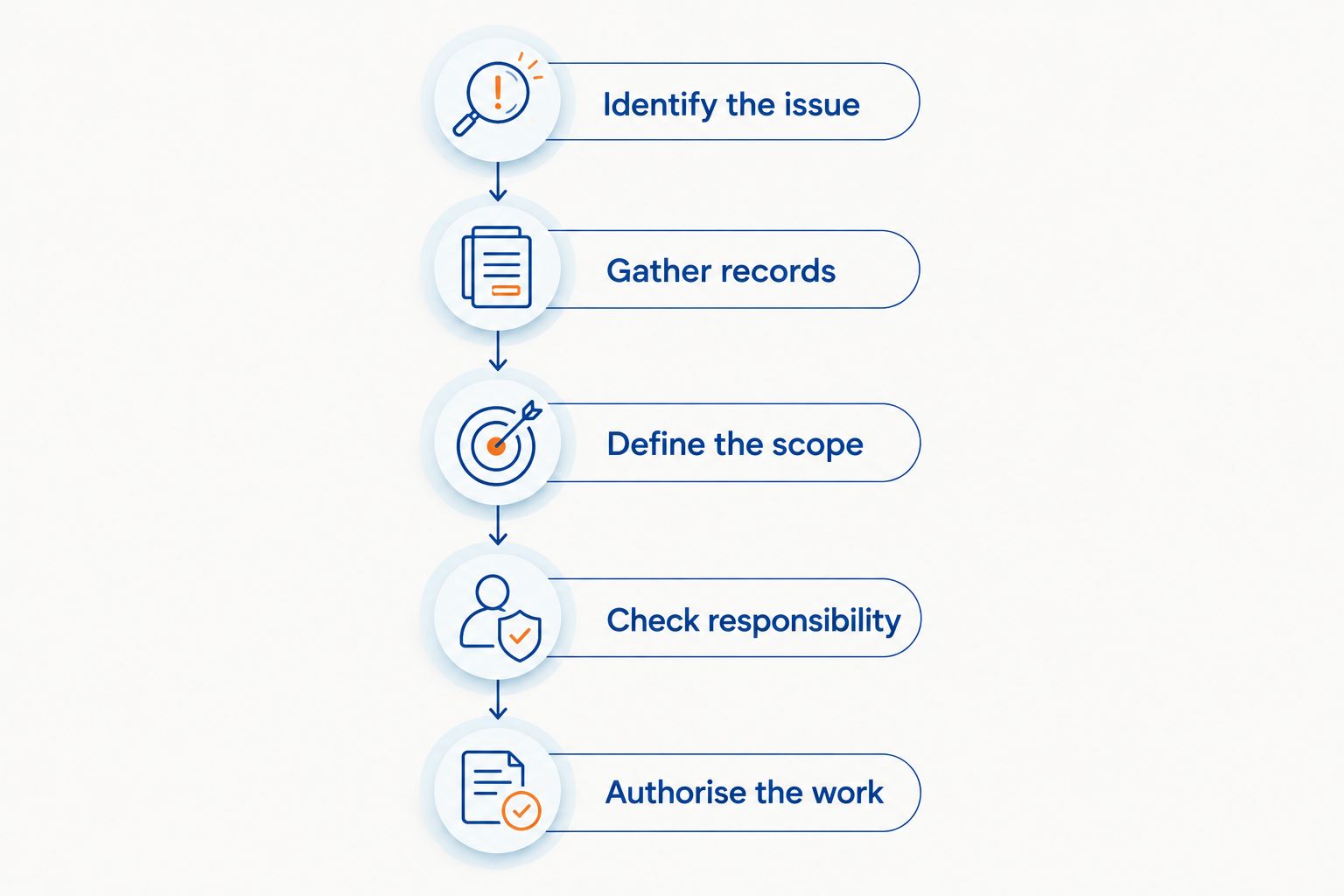
The practical test is simple: can you explain what the representative will do and what remains your responsibility? If not, clarify the instruction before signing.
Let us handle your case
Discuss your valuation, property split or merger, or council dispute and confirm the instruction in writing.
When staying with corporate commercial surveyors is right
Stay with a corporate commercial surveyor when the agreed appointment covers the work you need and you understand who is responsible for it. An existing representative with the relevant documents and case history does not become unsuitable merely because another provider offers a narrower service.
A broader property instruction can also justify keeping rating work alongside other advice. Check that the rating element is expressly included rather than relying on the firm's general service list.
For 2026, retain the provider whose written appointment fits your case—not the provider with the longest service menu. Switching is a decision about scope and responsibility, not a shortcut to a different valuation outcome.
FAQ
What’s the best alternative to corporate commercial surveyors for business rates?
Appeal My Rates UK is a direct fit for business owners in England and Wales seeking professional rating representation. Its stated services include valuation challenges, property splits and mergers, and disputes with local council rates teams.
Is a specialist rating surveyor better than a corporate firm?
A specialist rating surveyor fits a rates-focused instruction; a corporate firm can fit an appointment involving wider property advice. Compare the actual scope and responsibilities rather than treating either category as automatically better.
Can I challenge my business rates without a surveyor?
You can handle a business rates challenge yourself. You remain responsible for the evidence, submissions, correspondence and applicable procedural requirements.
Should I contact the council or challenge my rateable value?
Contact the council for a billing or account issue; use the applicable valuation process to dispute the underlying rateable value. Identify the disputed decision before choosing the route.
Is all your work no win, no fee?
Most of our work is no win, no fee, but some instructions carry fixed fees. Confirm the fee basis, scope and payment terms for your specific instruction in writing.
Can a business rates representative guarantee a reduction?
An appointment does not guarantee a business rates reduction. The case needs supporting evidence and must succeed through the relevant process.
What should I check before appointing a surveyor in 2026?
Check the written scope, responsibilities, relevant experience and appointment terms before authorising work. Confirm who gathers evidence, handles submissions and responds to correspondence.
One last thing
A corrected bill and a corrected valuation are different outcomes. A billing correction can resolve an account error without changing the property's rateable value; a valuation change still needs to be reflected in the council's account.
Ask your representative to identify the intended outcome in plain language. That single distinction makes corporate commercial surveyors alternatives easier to compare and gives you a clearer brief for whoever handles the case.
Related guides
- Compare business rates consultant fee terms
- How to appeal business rates in 2026
- Can my business rates go up after an appeal?
