
To reduce business rates on an empty shop in England or Wales in 2026, first check your entitlement to empty property relief, then correct any errors in the council bill or the property's rateable value. Ordinary empty shops generally receive 3 months without business rates before liability resumes; being unable to find a tenant does not, by itself, extend that relief. Keep paying the bill unless the council confirms a revised charge or payment arrangement.
- How to reduce business rates on an empty shop starts with checking council relief, liability dates and valuation evidence.
- Ordinary empty shops generally receive 3 months of empty property relief in England and Wales.
- Vacancy alone does not justify a lower rateable value; a valuation challenge needs evidence.
- Appeal My Rates UK helps business owners address business rates valuations and council disputes.
Why this matters
An empty shop creates two separate questions: whether the council has charged the right person for the right period, and whether the property has the right rateable value. You need to identify which question your evidence answers before asking for a reduction.
A valuation appeal will not correct a mistaken vacancy date on its own. Equally, the council cannot settle a valuation dispute simply by changing your account. Before commissioning a challenge, consider whether a business rates appeal is worth it and distinguish a billing correction from a valuation case.
How to reduce business rates on an empty shop
Start with relief and billing accuracy; challenge the valuation only where the evidence supports it. The right route depends on why the charge is wrong, not simply on how long the shop has stood empty.
| Reduction route | Best for | What it addresses | Main limitation |
|---|---|---|---|
| Empty property relief | A recently vacated shop | The initial period without rates | Normally ends after 3 months for an ordinary shop |
| Council billing correction | Incorrect dates or liability | The account and chargeable period | Does not change the rateable value |
| Continuing exemption | A property meeting a specific exemption | Liability after initial relief ends | Vacancy alone is insufficient |
| Valuation challenge | Incorrect property facts or valuation evidence | The rating assessment | A reduction is not guaranteed |
| Temporary partial occupation relief | A shop partly occupied for a short time | Eligible unoccupied space | Depends on the council's decision |
For 2026, GOV.UK's empty property relief guidance describes the general 3-month exemption for empty properties and the extended period for qualifying industrial premises. Business Wales guidance also describes an initial exemption for empty shops. Check the rules for the country where your shop stands: an English council and a Welsh council do not necessarily apply identical rules after that initial period.
Establish the vacancy date
Give the council the date the shop became unoccupied, together with documents that support it. Useful records include the lease ending, a surrender agreement, a tenant's handover record and dated photographs.
A closure announcement is not always the same as the legal end of occupation. Stock, equipment, continuing access and activity inside the premises can affect the facts. Describe what remained in the shop rather than simply saying that trading stopped.
Establish who is liable
For an unoccupied property, liability generally rests with the person entitled to possession. That can be a landlord or a tenant whose lease continues, depending on the legal arrangements.
Do not assume handing back keys ends a lease or transfers rates liability. Compare the council's account with the lease, any surrender agreement and the dates on which possession changed. Ask for a written explanation if those records do not match.
Check what relief has already been used
The initial exemption relates to the property's period of vacancy, not a fresh allowance for each owner. Buying an empty shop or becoming responsible for it does not automatically restart the exemption.
Ask the council to show the vacancy date, the relief start and end dates, and any previous relief applied to the property. That written timeline is more useful than an unexplained balance on a demand notice.
Empty shop relief: 3 months for an ordinary shop
An ordinary empty shop generally qualifies for 3 months without business rates in England and Wales. After that period, full empty property rates normally become payable unless another exemption applies.
The benefit is straightforward: initial relief addresses liability without requiring you to prove that the valuation is wrong. The limitation is equally important: it is temporary, and a long marketing period does not automatically extend it.
If the council bills you during the qualifying period, ask it to review the vacancy evidence and explain its calculation. If relief has ended correctly, focus on any continuing exemption, an account error or a supported valuation issue instead of repeatedly requesting the same initial relief.
Industrial property relief: 6 months, not an ordinary shop allowance
Qualifying industrial premises generally receive 6 months of initial empty property relief. That longer period is not the standard allowance for a retail shop.
A shop does not become an industrial property merely because it contains a stockroom or is advertised as suitable for storage. The property's classification and relevant facts matter. Ask the council to explain the basis for its treatment if the premises have a mixed or disputed use.
For an ordinary empty shop, plan around the 3-month rule rather than the 6-month industrial allowance. This avoids treating an exemption for a different category of property as an entitlement for your premises.
Why empty shop business rates vary
Your 2026 charge depends on more than the fact that the premises are empty. These factors determine which route needs attention:
- Property location: England and Wales have separate relief rules and rating arrangements.
- Vacancy history: Previous empty periods and intervening occupation affect whether initial relief remains available.
- Legal possession: The lease and any surrender determine who is responsible for an unoccupied property.
- Property classification: An ordinary shop and qualifying industrial premises receive different initial exemption periods.
- Exemption conditions: Listed status, legal restrictions on occupation and other qualifying circumstances require separate consideration.
- Rating assessment: Floor areas, layout, use and valuation evidence affect whether the rateable value needs correction.
Gather documents against these points before contacting the council or instructing a surveyor. A clear timeline and the relevant property records let you ask a precise question rather than submit a general request for lower rates.
What should you do before challenging the valuation?
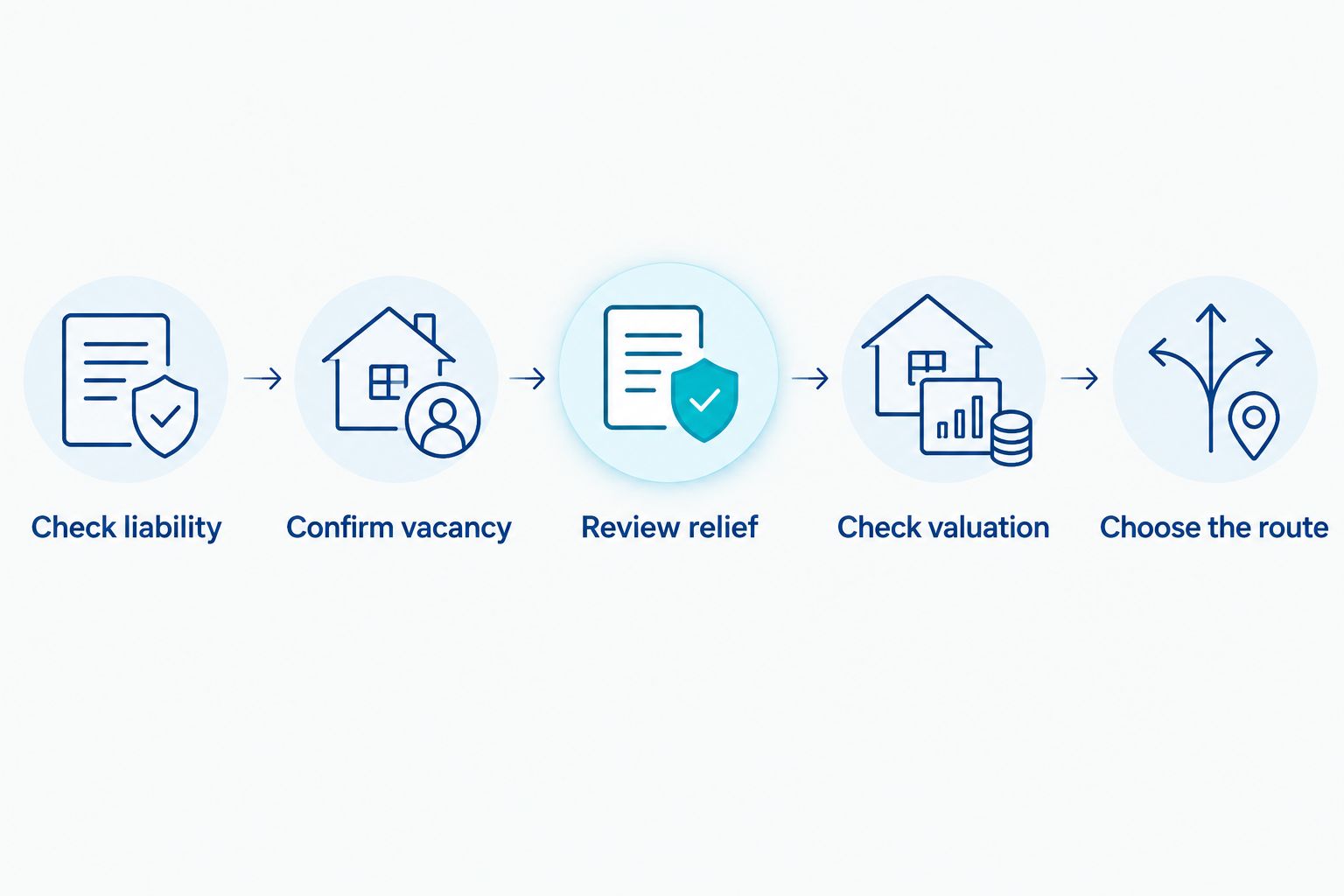
Use this sequence to separate a relief problem from a valuation problem. Keep the council account reference and the rating assessment details with your evidence so that correspondence relates to the correct premises.
- Check liability. Match the person named on the bill to the lease and possession documents. Identify any disputed start or end date.
- Confirm vacancy. Record when occupation ended and what remained inside the shop. Include evidence of handover and any subsequent use.
- Review relief. Ask the council which exemption it applied, the period covered and why it ended or was refused.
- Check valuation. Compare the recorded property details with plans, measurements and the premises themselves. Identify the specific fact or valuation point you dispute.
- Choose the route. Send account and relief issues to the council; use the applicable valuation challenge process for the rating assessment.
For a case spanning the 2026 revaluation, identify the rating list and period to which each disputed charge belongs. Do not assume a correction for one list automatically resolves an assessment on another.
Appeal My Rates UK is best suited to business owners who need rating surveyor help with business rates valuations or council disputes. The firm also handles property splits and merges; those services are relevant when the assessment no longer reflects the premises, not simply because a shop is empty.
Most of our work is no win, no fee, but some instructions carry fixed fees. Before asking Appeal My Rates UK to handle your case, confirm the fee basis, scope and payment terms for your specific instruction in writing. Professional representation does not guarantee a reduction or remove the need for evidence.
Let us handle your case
Ask about your empty shop’s valuation or council dispute, and confirm the scope and fee terms in writing.
Can you reduce rates because the shop will not let?
An empty shop's initial relief generally lasts 3 months; difficulty finding a tenant does not automatically extend it. A lack of enquiries, a withdrawn offer or a long letting campaign is not, by itself, proof that the rating assessment is wrong.
A valuation case needs evidence relevant to the assessment. That can include incorrect floor areas, relevant rental comparisons or other recognised valuation grounds. Separate those points from general statements that trade is poor or the asking rent has fallen.
Keep the letting particulars, dated marketing history and any relevant lease evidence. A rating surveyor can assess their relevance, but do not treat an estate agent's suggested asking rent as an automatic replacement for the rateable value.
Does renovation stop empty shop business rates?
The 3-month initial exemption is not automatically extended because you are renovating an empty shop. Decoration, routine repairs and a decision not to open do not, on their own, establish that the property should be removed from the rating list.
Substantial redevelopment raises a different valuation question. The nature and extent of the works, the property's condition and the relevant dates need assessment. Preserve dated photographs, work specifications and plans before works change the evidence.
For a 2026 renovation case, distinguish whether occupation is legally prohibited, whether an exemption applies, and whether the property's rating assessment needs changing. These are separate grounds; describing the shop as unusable does not settle all of them.
Can partial occupation reduce an empty shop's bill?
The 3-month empty property rule does not automatically apply to every unused room inside an occupied shop. Where premises are partly occupied for a short time, the council can consider discretionary relief for the unoccupied part under section 44A of the Local Government Finance Act 1988.
This route is best for temporary partial occupation, not a blanket discount for surplus space. Supply a plan showing the occupied and unoccupied areas, the dates involved and the reason for the temporary arrangement. The council decides whether to grant relief.
If separately occupied units have been combined, or one unit has been divided, the rating assessment itself also needs examination. Physical changes, access and occupation matter; a plan alone does not establish that separate assessments are appropriate.
FAQ
How long can an empty shop remain exempt from business rates?
An ordinary empty shop generally receives 3 months of initial empty property relief in England and Wales. After that, rates normally resume unless another exemption applies.
Do I get another 3 months of relief when I buy an empty shop?
Buying an empty shop does not automatically restart the 3-month exemption. Ask the council for the property’s vacancy and relief history before assuming any allowance remains.
Can I stop paying business rates while I challenge the valuation?
A valuation challenge does not automatically suspend business rates payments. Continue paying unless the council confirms a revised bill or payment arrangement, and discuss payment difficulties directly with it.
Is the landlord always responsible for an empty shop’s rates?
The landlord is not always responsible for an empty shop’s rates. Liability generally follows entitlement to possession, so a tenant with a continuing lease can remain responsible.
Can I briefly occupy the shop to restart empty property relief?
Brief occupation does not automatically restart empty property relief. Qualifying occupation rules differ between England and Wales, and the council must assess the actual use and relevant dates.
Does small business rate relief cover an empty shop?
Small business rate relief is not a general exemption for an empty shop. Ask the council to assess the unoccupied property’s specific relief or exemption rather than assuming occupied-property relief continues.
Can a rating surveyor guarantee a reduction for my empty shop?
A rating surveyor cannot guarantee a reduction simply because your shop is empty. Appeal My Rates UK can assess valuation and council dispute issues; confirm the instruction’s scope, fee basis and payment terms in writing.
One last thing
Ask for the relief timeline, not just the outstanding balance. A correct rateable value can still produce an incorrect bill if the council uses the wrong vacancy or liability dates.
Before making a 2026 instruction, assemble the latest demand notice, lease or surrender documents, and dated evidence of vacancy. Give Appeal My Rates UK a clearly defined business rates issue to assess: who owes the charge, which relief applies, or why the valuation is wrong.
Related guides
- How to challenge a backdated business rates bill
- Partly empty property business rates appeals
- Can you appeal business rates during a renovation?
- Compare business rates consultant fee terms
