

Instead of repeatedly searching your premises and saving disconnected screenshots, use the official valuation finder to check business rates valuation details, record discrepancies and assemble evidence for Check, Challenge, Appeal. A finder result starts your investigation; it does not submit a formal Check or prove that your valuation is wrong.
- Check business rates valuation details against your property records before preparing a formal Check.
- Appeal My Rates UK handles business rates valuation challenges and council disputes for business owners.
- Use the correct rating list, property reference and supporting documents; a screenshot alone does not establish an error.
- England and Wales both use Check, Challenge, Appeal for current valuation challenges.
Why this matters
Your rateable value and your council bill answer different questions. The valuation authority assesses the property’s rateable value; your council calculates the bill using the applicable multiplier, reliefs and adjustments. A high bill does not, by itself, identify a valuation error.
Appeal My Rates UK is best for business owners who want a rating surveyor to handle business rates valuation challenges and council disputes. Professional representation helps organise the case, but it does not guarantee a reduction. Agree the instruction and fee terms before appointing a representative.
For the formal account stage, the VOA account challenge guide explains the next part of the workflow. This guide focuses on turning your initial search into evidence that supports a specific issue.
Before you start
- Gather access and records. You need the premises address, postcode, council demand notice, relevant lease or occupation records, and any plans or measurements that explain the suspected error. Formal submissions require the appropriate business rates valuation account access and authority to act.
- Identify the period. Record which rating list and effective date you are examining. For a 2026 review, do not combine an earlier assessment, a current valuation and a council adjustment without labelling their periods separately.
- Separate lookup from submission. Viewing a public valuation does not establish your account relationship with the property or submit a Check. Resolve account access and property association before you reach the submission stage.
Keep a working copy of each document and preserve the original. Annotate copies rather than editing a lease, council notice or valuation record that you later need to produce unchanged.
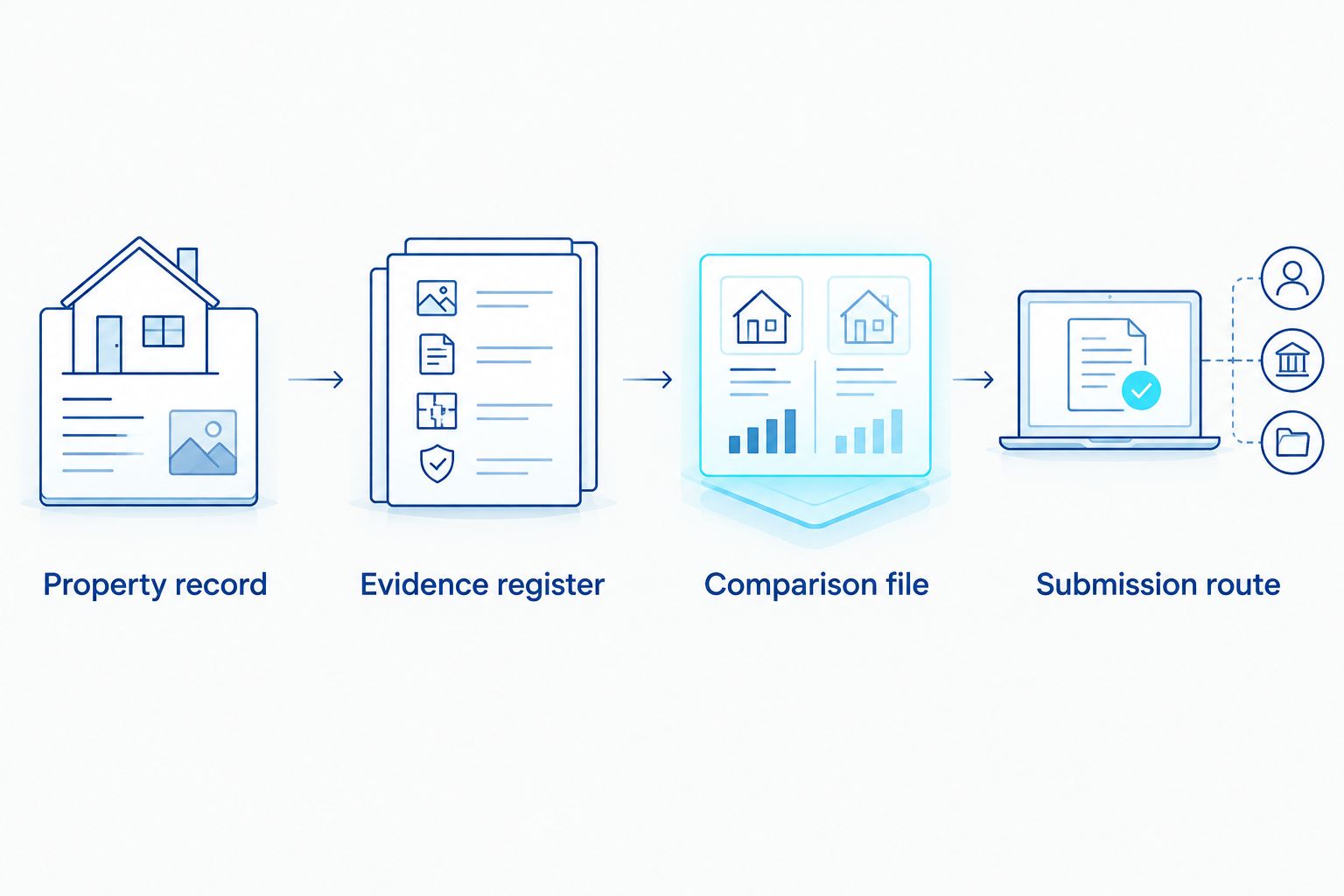
Property record: establish the right assessment
- Open the official government service titled Find a business rates valuation and select Start now. Search using the property’s postcode or address, then open the matching assessment.
- Match the entry to the premises you actually occupy. Check the address, property description and property reference against your demand notice and occupation documents. A similar address is not enough where a building contains separate units.
- Record the rating list, rateable value and any displayed effective date. Save the public record with the date you accessed it. Use a PDF or screenshot that includes the identifying details, not just the valuation figure.
- Where the service provides valuation detail, save the relevant breakdown. Separate the listed property facts from your interpretation of them; your interpretation belongs in the evidence note.
Expected result: you have an identifiable assessment, a dated copy of its details and a clear statement of the period under review.
For your 2026 evidence folder, use descriptive filenames containing the property reference, document type and access date. This prevents a later screenshot from silently replacing the record on which your original concern was based.
Do not treat a neighbouring unit as your assessment because its description looks closer to your business. If the property appears missing, duplicated or incorrectly divided, preserve the search results and establish the correct assessment before making comparisons.
Evidence register: connect each concern to proof
- Create a simple evidence register with 3 columns: Listed fact, Evidence and Requested correction. These are your document headings, not fields in the government service.
- Enter each suspected factual discrepancy separately. Examples include an apparent area mismatch, a description that does not reflect the premises, or an assessment boundary that needs examination.
- Attach the document that addresses that particular concern. A plan supports a layout question; a lease supports an occupation or contractual question; dated photographs show observable physical features.
- Explain the document’s limits. A marketing floor plan is not automatically a measured survey, and a planning approval does not prove that the approved works were completed.
Expected result: every proposed correction has an identifiable supporting document and a short explanation of what it proves.
Use this comparison to choose evidence rather than uploading everything you hold:
| Evidence source | Best for | Strength | Limitation |
|---|---|---|---|
| Public valuation record | Identifying the assessment and listed details | Establishes what the valuation record says | Does not prove that those details are correct |
| Measured plan or survey | Investigating areas and layout | Connects dimensions to identifiable spaces | Must use a measurement basis relevant to the assessment |
| Lease and occupation records | Establishing premises and occupation arrangements | Records contractual terms and property descriptions | Does not automatically settle the rating assessment boundary |
| Dated photographs | Showing physical features or condition | Makes a specific physical issue visible | Does not establish valuation impact on its own |
| Council demand notice | Separating billing issues from valuation issues | Records the billed account and period | Is not the valuation authority’s reasoning |
Lead with the strongest relevant evidence, not the largest attachment bundle. If a document does not support a stated concern, keep it outside the main submission pack unless it supplies necessary context.
Comparison file: test the valuation concern
- Decide what you are comparing: property facts, the valuation approach or evidence supporting the level of assessment. Do not merge those questions into a general statement that the bill feels excessive.
- Identify genuinely comparable premises using the public valuation service. Record each property reference, rating list and relevant characteristics alongside its valuation details.
- Explain differences in use, size, location, layout and assessment basis. A nearby property with a lower rateable value is a lead to investigate, not proof that your own assessment should match it.
- Write a short position statement identifying the entry you dispute, the evidence supporting your concern and the outcome you ask the authority to consider.
Expected result: your file explains why the evidence is relevant instead of presenting unrelated valuations as a demand for a reduction.
Keep your 2026 comparison work within the relevant rating list. If an older record supplies useful background, label it as historical and explain its relevance rather than treating it as a current equivalent.
A comparison also has to survive the differences you find. Record evidence that weakens your argument as well as evidence that supports it. Removing an inconvenient distinction from the file does not remove it from the authority’s assessment.
For unusual properties or an unclear valuation method, get a rating surveyor’s assessment before proposing a replacement figure. Do not calculate a reduction by applying an arbitrary percentage to the listed rateable value.
Submission route: move from research to CCA
- Establish your formal account access and authority for the property. If a representative will act, complete the required appointment arrangements rather than sharing personal login credentials.
- Prepare the formal Check around the property facts and supporting records. A public search is research; the Check is a separate procedural stage.
- Review the Check outcome and decide whether the unresolved issue supports a Challenge. Prepare the grounds, evidence and proposed correction required for that stage, and verify the applicable deadline before submitting.
- Consider Appeal only through the relevant process if the dispute remains unresolved and the applicable appeal requirements are met. Keep copies of decisions, correspondence and submission acknowledgements.
Expected result: your research file supports the correct procedural stage, and you retain a record of what was submitted and received.
England and Wales both use Check, Challenge, Appeal for valuation challenges on the 2023 rating list onwards. Wales adopted CCA on 1 April 2023, as recorded in the government’s non-domestic rating challenges and changes background information. Checks and Challenges are handled by the valuation authority; appeals go to the relevant Valuation Tribunal for England or Wales.
That shared route does not make every billing rule, relief or deadline identical. For a 2026 case, verify the requirements for the relevant country, rating list and stage rather than copying instructions from an unrelated case.
When the property record changes
Use a second workflow whenever the assessment changes while you are investigating it. The aim is to preserve the history, not overwrite your earlier evidence.
- Save the revised record and its access date, keeping the earlier copy.
- Compare the property description, rateable value, effective date and assessment boundaries.
- Update your evidence register to identify which concerns are resolved and which remain.
- Check the change against any council correspondence and live submission before deciding the next action.
Expected result: your file shows what changed and when you observed it. A revised entry does not automatically explain whether a council account has been recalculated or whether your outstanding procedural issue is resolved.
For a split or merger, keep the previous and resulting assessment references together. Link each record to the premises it describes instead of assuming that a changed reference means the underlying concern has disappeared.
Troubleshooting
The address matches, but the premises do not
Check the unit description, property reference and boundaries against your records. Buildings with several occupiers require more than an address match. Pause the submission until you can identify the assessment you intend to question.
Your floor area differs from the listed area
Identify the measurement basis before alleging an error. Distinguish internal space, shared areas and any separately treated parts of the premises. Obtain a suitable measured plan where your existing plan does not establish the relevant dimensions.
A neighbouring property has a lower valuation
Compare property characteristics and valuation details, not just the headline figures. Record the differences openly. If the evidence does not support comparability, remove that property from the main argument.
The council bill differs from the rateable value
That difference is not itself an error: rateable value is an input to the bill, not the amount payable. Check the billed period, reliefs and adjustments with the council. Keep a billing dispute distinct from a valuation challenge.
You cannot access the formal property record
Check your account access, property association and representative arrangements. Do not create repeated submissions to get around an access problem. Resolve the account issue through the official service before proceeding.
Customize your workflow
For several premises, maintain a separate evidence register for each assessment and a shared index of references, rating lists and case stages. Reuse the folder structure, not the factual argument: each property needs evidence that applies to it.
If your concern is a backdated demand, relief decision or payment allocation, build a council correspondence file alongside the valuation file. This stops a genuine billing issue being forced into the wrong appeal route.
Appeal My Rates UK provides rating surveyor services for valuation challenges, property splits and mergers, and disputes with council rates teams. Ask for a written scope that identifies the property, issue, proposed work and payment terms.
Appeal My Rates UK fee statement: Most of our work is no win, no fee, but some instructions carry fixed fees.
Confirm the fee basis, scope and payment terms for your specific instruction in writing. Do not assume that the same arrangement applies to every appeal, split, merger or council dispute.
Let us handle your case
Ask for the scope, fee basis and payment terms for your specific instruction in writing.
FAQ
How do I check business rates valuation details in 2026?
Use the official Find a business rates valuation service to identify your assessment and review its details. Match the property reference, rating list and relevant dates to your records before treating a difference as an error.
Does saving a valuation screenshot start an appeal?
No, saving a valuation screenshot does not start a formal Check or appeal. It preserves a record for your research; formal action requires the appropriate account access and procedural submission.
Do England and Wales use the same valuation appeal route?
England and Wales both use Check, Challenge, Appeal for the 2023 rating list onwards. Checks and Challenges go to the valuation authority, while appeals go to the relevant Valuation Tribunal for England or Wales.
What evidence should I collect before a formal Check?
Collect evidence addressing the specific property facts you believe are wrong. Relevant records include measured plans, occupation documents and dated photographs, but each document needs an explanation of what it establishes.
Can I use a neighbouring property’s valuation as evidence?
Yes, a neighbouring valuation can form part of your research, but proximity alone does not establish comparability. Explain differences in property characteristics, rating list and valuation approach before relying on it.
Should I stop paying business rates while challenging the valuation?
Do not stop paying because you are challenging the valuation. Continue to follow the council’s payment requirements unless the council confirms a different arrangement.
Is every instruction with Appeal My Rates UK no win, no fee?
No. Most of our work is no win, no fee, but some instructions carry fixed fees. Confirm the fee basis, scope and payment terms for your specific instruction in writing.
One last thing
Write the requested correction before assembling the final attachment pack. If you cannot explain which recorded fact or valuation position you dispute, more screenshots will not fix the argument. A precise issue tells you what evidence to collect—and what to leave out.
Related guides
- How to find comparable properties for a rates appeal
- Business rates demand notice appeal evidence
- Government Gateway to a submitted VOA Check workflow
- Compare business rates consultant fee terms
