

Yes, charities can get 100% business rates relief on eligible properties in England and Wales in 2026: qualifying occupied premises receive 80% mandatory charitable relief, and the council can award discretionary relief covering the remaining 20%. The extra relief is not automatic, and charitable status alone does not establish that every property qualifies.
- Can charities get 100 percent business rates relief? Yes, when mandatory charitable relief and discretionary relief cover the bill.
- Eligible occupied charitable premises receive 80% mandatory relief; the council decides whether to cover the remaining 20%.
- Apply to the billing council for charitable relief, not through a valuation appeal.
- Appeal My Rates UK helps with business rates council disputes and valuation challenges; neither route guarantees a reduction.
Why this matters
An 80% reduction and a fully relieved bill are different outcomes. If your council awards mandatory relief but refuses the discretionary top-up, your charity still has a remaining liability. Budget against the written award, not the percentage you requested.
Appeal My Rates UK business rates services are best for charities needing help with council disputes or valuation challenges. First establish whether your problem concerns relief, the bill, or the property's rateable value. Each needs a different response.
Can charities get 100% business rates relief?
For qualifying occupied properties in 2026, the usual route to full charitable relief combines a mandatory award with a discretionary top-up. The council handles both, but the legal basis and decision are different.
| Relief component | Reduction available | Best for | Benefit | Limitation |
|---|---|---|---|---|
| Mandatory charitable relief | 80% of the qualifying bill | Charities occupying premises wholly or mainly for charitable purposes | Statutory entitlement when the conditions are met | Does not normally remove the entire bill |
| Discretionary charitable top-up | Up to the remaining 20% | Eligible charities seeking full relief | Can bring total relief to 100% | Depends on the council's decision and policy |
The statutory starting points are sections 43 and 47 of the Local Government Finance Act 1988. GOV.UK's charitable rate relief guidance explains the 80% mandatory award and the council's discretion over the balance; Welsh Government business rates relief guidance covers charitable relief in Wales.
These percentages describe relief against the qualifying rates liability, not a reduction in the property's rateable value. A council relief award does not, by itself, change the valuation recorded in the rating list.
Check eligibility before treating 100% relief as an entitlement. England's exclusion of private schools from charitable rate relief is particularly important: charitable status does not override that exclusion, although statutory exceptions apply.
Mandatory charitable relief: 80%
Mandatory charitable relief generally applies where the ratepayer is a charity or trustees for a charity and the occupied property is used wholly or mainly for charitable purposes. Those purposes can belong to the occupying charity or to that charity and other charities.
The practical question is not simply whether your organisation has a charity number. It is who occupies the property and what happens there. Explain the activities carried out at the premises and how they serve charitable purposes.
Useful evidence includes your governing document, occupation agreement, property plan and records of activities. Registration evidence helps establish status, but it does not replace evidence of qualifying use. Some charities are exempt from registration, so the absence of a registration number is not, on its own, the whole eligibility test.
For your 2026 application, connect each document to the property concerned. A general description of your charity's mission tells the council less than a clear account of how the building supports that mission.
Discretionary charitable top-up: up to 20%
A council can use its discretionary powers to cover some or all of the liability remaining after mandatory charitable relief. A full top-up brings the combined reduction to 100%.
Ask explicitly for the discretionary top-up. Do not assume that an application for mandatory relief includes a request for every discretionary award available. Check the council's application form and published policy, then identify the relief you are seeking.
The benefit is clear: a full award removes the remaining qualifying rates liability. The limitation is equally clear: the top-up is not a statutory entitlement merely because the mandatory award has been granted.
Your council's policy sets the relevant local criteria and supporting evidence. Answer those criteria directly rather than submitting a generic appeal for financial help. Keep the mandatory entitlement and discretionary request separate in your covering explanation so the council can identify both decisions.
Why charitable business rates relief varies
The headline percentages do not settle every application. These factors determine whether a property qualifies and whether full relief is awarded:
- The liable occupier: the organisation named on the bill and the actual occupation arrangements matter. Ownership by a charity is not enough for occupied-property relief.
- The property's use: mandatory relief requires qualifying charitable use, not simply a charitable organisation somewhere in the ownership structure.
- The council's discretionary policy: the remaining 20% depends on the local decision, rather than following automatically from the mandatory award.
- Occupied or empty status: empty charitable property has a different statutory test. Do not apply the occupied-property explanation unchanged.
- Specific exclusions and conditions: private schools in England and charity shops require attention to the rules applicable to their circumstances.
England and Wales share the broad 80% mandatory charitable relief structure, but that does not make every local policy or property-specific rule identical. For a 2026 claim, use the guidance for the property's country and the billing council's current discretionary policy.
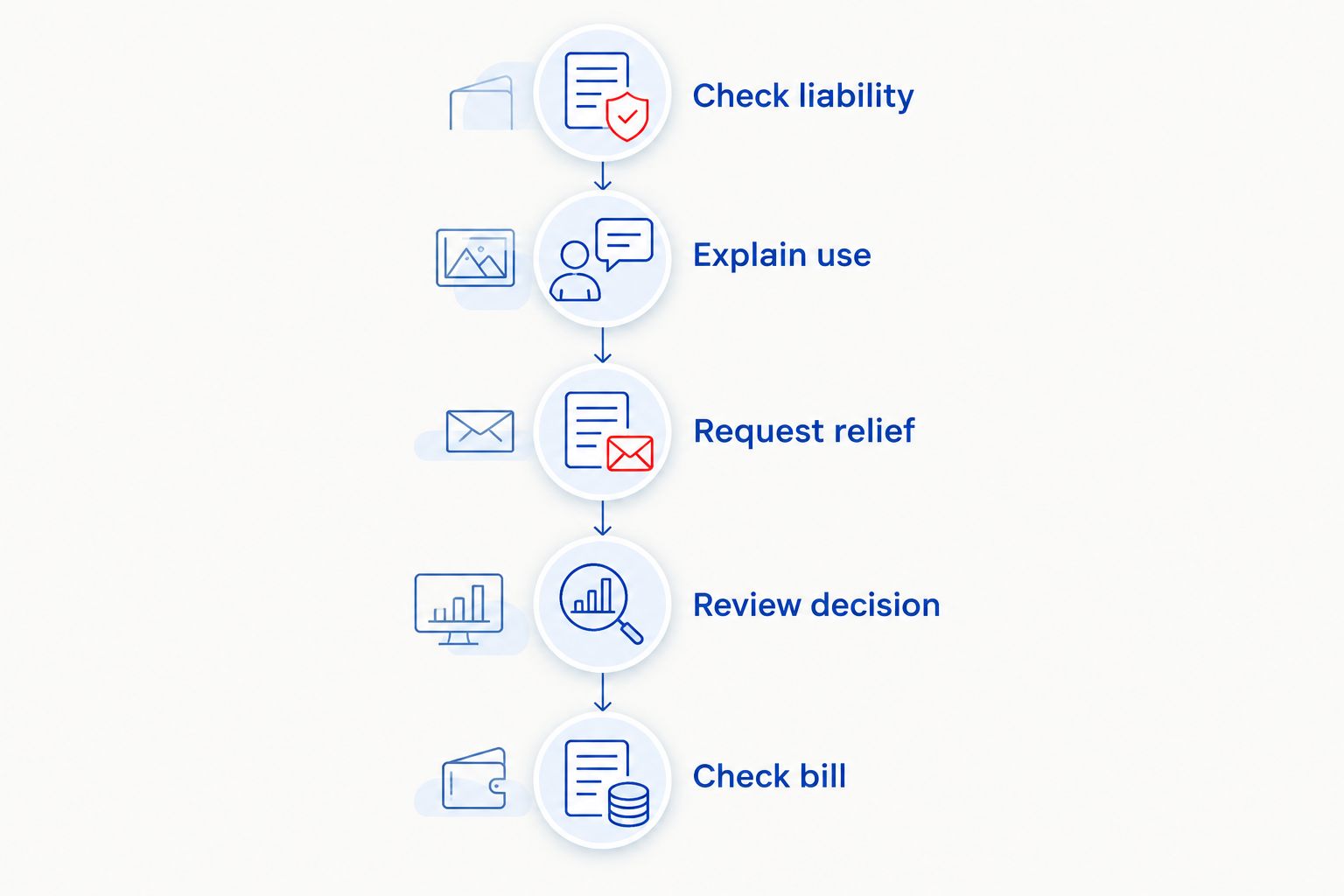
How do I apply for full charitable relief?
Apply to the local authority that issues the business rates bill. A request for charitable relief concerns the council's calculation of liability; it is not a Check, Challenge, Appeal valuation submission.
- Check liability. Match the property address, liable organisation and occupation dates against the demand notice and your records. Explain discrepancies before relying on the bill as the basis for your application.
- Explain use. Describe the charitable activities carried out at the premises. Include plans or activity records where they help distinguish charitable use from other uses.
- Request relief. Ask for mandatory charitable relief and, where appropriate, the discretionary top-up. State the period you want the council to consider and supply the evidence its policy requests.
- Review decision. Read the written outcome for each relief component. Identify whether a refusal concerns charitable status, property use, the evidence supplied or discretionary criteria.
- Check bill. Compare the revised demand notice with the award. Confirm that the effective dates, property and relief entries match the written decision.
Keep copies of the application, attachments and correspondence. If a document was missing, provide it with a short explanation of what it proves. If the council has misunderstood the occupation arrangements, address that point rather than resending the same application unchanged.
Can a charity shop get full business rates relief?
100% relief is possible for a qualifying charity shop, but the mandatory award and discretionary top-up remain separate. The charity-shop test includes whether the property is wholly or mainly used to sell donated goods and whether the proceeds, after expenses, are applied to charitable purposes.
A shop sign or charity registration certificate does not establish those trading facts. Explain what the shop sells and how the proceeds are used. Where donated and bought-in goods are both sold, provide evidence that addresses the qualifying-use test rather than assuming all retail activity counts.
Keep stock and financial records that support your explanation. The council needs evidence about this shop, not just confirmation that the wider organisation undertakes charitable work.
Can an empty charity-owned property get 100% relief?
100% relief can apply to qualifying empty charitable property, but charity ownership alone does not settle the question. The empty-property rules require the ratepayer to be a charity or trustees for a charity, with the property expected to be used next wholly or mainly for charitable purposes.
Explain the intended next use and provide evidence supporting it. A documented plan for charitable occupation is more useful than a bare statement that the building belongs to a charity.
Tell the council when the property became empty and whether the intended occupation changes. Do not treat an award made while the property was occupied as confirmation that the empty period is covered. Ask for a decision addressing the actual circumstances and dates.
What if the council awards only 80% relief?
80% relief means the mandatory award has not been topped up to full relief. Read the decision to establish whether the council refused the discretionary element, awarded only part of it, or has not yet decided it.
Request the reasons and identify the applicable policy criteria. Then address the specific issue: missing evidence needs documents; a factual misunderstanding needs correction; a discretionary refusal needs a response to the council's stated reasoning.
Ask the council to explain any available review or complaints procedure. Do not stop paying an outstanding demand merely because you disagree with it; obtain written confirmation of any revised liability or payment arrangement.
Relief refusal or valuation error: which should you challenge?
A charity can have a valid relief issue and a separate valuation issue. Use the council route for charitable relief and the valuation route for an incorrect rateable value. Sending a relief complaint through the valuation process does not resolve the council's discretionary decision.
For current rating-list valuation challenges in 2026, England and Wales both use Check, Challenge, Appeal. Checks and Challenges are handled by the valuation authority; an appeal goes to the relevant Valuation Tribunal for England or Wales.
Start a valuation case with evidence about the assessment itself, such as property measurements, occupation boundaries or relevant valuation comparisons. The business rates finder and appeal evidence guide explains that evidence-focused starting point.
A lower valuation and a relief award are not interchangeable. Even where full relief currently removes liability, changes in use or eligibility make accurate property records important. Check the facts before choosing a route.
When should you ask for professional help?
Ask for help when the dispute turns on occupation, property boundaries, a split or merger, conflicting records, or the distinction between a council billing problem and a valuation error. A routine application with clear evidence does not automatically need professional representation.
Appeal My Rates UK handles business rates valuation challenges, property splits and mergers, and disputes with council rates teams. The benefit is help presenting the case and dealing with the relevant authority; the limitation is that representation cannot guarantee eligibility, a discretionary award or a valuation reduction.
Service note from Appeal My Rates UK: Most of our work is no win, no fee, but some instructions carry fixed fees. Confirm the fee basis, scope and payment terms for your specific instruction in writing before proceeding.
Let us handle your case
Tell us about your charity’s rates bill or valuation and we will confirm the fee basis for your instruction in writing.
FAQ
Can charities get 100 percent business rates relief in 2026?
Yes, qualifying occupied charitable premises can receive 100% relief when the 80% mandatory award is supplemented by a full discretionary top-up. The council decides whether to award the remaining 20%.
Does charity registration automatically remove the business rates bill?
No, charity registration alone does not automatically remove the business rates bill. Eligibility also depends on the liable occupier, the property’s use and any applicable exclusions; full relief normally needs a discretionary top-up.
Do charities in Wales get the same 80% mandatory relief?
Yes, eligible occupied charitable premises in Wales receive 80% mandatory charitable relief. The council can award discretionary relief against the remaining liability, but local policies and property-specific conditions still need checking.
Can a charity shop get 100% business rates relief?
Yes, a qualifying charity shop can receive 100% relief if the council awards a full discretionary top-up. The mandatory charity-shop test includes wholly or mainly selling donated goods and applying the proceeds, after expenses, to charitable purposes.
Can the council refuse the extra 20% relief?
Yes, the council can refuse the discretionary 20% top-up even where mandatory charitable relief applies. Ask for the written reasons and respond to the relevant policy criteria.
Do I use Check, Challenge, Appeal to apply for charitable relief?
No, apply to the billing council for charitable relief. England and Wales both use Check, Challenge, Appeal for current rating-list valuation disputes, not to decide a discretionary charitable relief application.
Can an empty charity property qualify for full relief?
Yes, qualifying empty charitable property can receive full relief under the empty-property rules. The ratepayer must meet the charitable-status requirement and the property must be expected to be used next wholly or mainly for charitable purposes.
Is help from Appeal My Rates UK always no win, no fee?
Most of our work is no win, no fee, but some instructions carry fixed fees. Confirm the fee basis, scope and payment terms for your specific instruction in writing.
One last thing
Ask the council to confirm mandatory relief and the discretionary top-up separately. A letter approving charitable relief does not necessarily say that the entire bill has been removed. Match the written percentages and effective dates to the revised demand notice before recording the liability as fully relieved.
Related guides
- How to appeal business rates in 2026
- How to challenge a backdated business rates bill
- Compare business rates consultant fee terms
