

Subletting part of your property can change who pays business rates and whether the premises need separate rating assessments; it does not automatically reduce your bill. The outcome depends on who actually occupies and controls each area, not just what the sublease says. You also need to check the effect on relief, because a smaller assessment does not by itself guarantee a smaller combined liability.
- The subletting business rates effect depends on actual occupation, control and whether separately occupied areas need separate assessments.
- A sublease clause can allocate costs between businesses without deciding who the council must bill.
- Check property splits, rateable value and relief together before assuming subletting saves business rates.
- Appeal My Rates UK helps business owners with rating assessments, property splits and council disputes.
Why this matters
Subletting creates a contractual arrangement between businesses, but business rates follow rating law. If those arrangements do not match the rating list and council records, you can face a bill that does not reflect the occupation on the ground.
For a subletting decision in 2026, establish the likely rating treatment before agreeing how you will share costs. Appeal My Rates UK provides business rates appeals and rating-surveyor services for owners and occupiers in England and Wales, including property splits and council disputes.
How does subletting part of my property affect my business rates?
Subletting changes business rates only where the occupation, assessment or relief position justifies a change. Signing a sublease does not automatically split the existing assessment or transfer part of your council account to the subtenant.
The distinction is between an independently occupied part of the building and space that remains within your occupation. A separate business using a clearly defined unit raises different questions from someone using a desk while you retain control of the office.
| Arrangement | Rating question | Potential benefit | Limitation or risk |
|---|---|---|---|
| Subtenant independently occupies a defined area | Should that area have its own assessment? | Liability can reflect separate occupation | Separate assessment does not guarantee lower combined bills |
| Businesses share space under your control | Does the property remain a single assessment? | A single account can keep administration simpler | You can remain liable despite receiving a contribution |
| Agreement includes a contribution towards rates | Who is legally liable, regardless of the contribution? | The agreement records how businesses share costs | A private agreement does not bind the council |
| Part of the building remains unused | Is the issue separate occupation or partial vacancy? | The correct facts identify the appropriate enquiry | Unused space does not automatically receive a reduction |
Treat these as assessment questions, not choices you can make simply by changing the wording of an agreement. The physical layout, rights granted and actual use all matter.
When the sublet area is separately occupied
A subtenant taking independent occupation of a distinct part of your premises can create grounds for a separate rating assessment. The valuation authority considers the facts; the council then deals with billing using the relevant rating-list entries and liability information.
Evidence of independent occupation can include a defined boundary, control over access and the right to use the space for the subtenant's own business. Shared corridors or toilets do not, on their own, settle whether the occupied accommodation should be assessed separately.
Do not assume your remaining rateable value falls in the same proportion as the floor area you let. Removing part of a property from your occupation is not a simple percentage calculation. The remaining accommodation still needs to be valued on its own facts.
Ask for the proposed treatment of both areas. Looking only at the subtenant's unit leaves you without an answer about your retained premises.
When you share space without giving up control
Sharing occupation is not necessarily the same as creating a separate rateable property. A desk user, visiting practitioner or business using facilities under your continuing control presents a different factual position from an occupier controlling a defined unit.
Calling an agreement a licence does not settle the issue, just as calling it a sublease does not guarantee separate assessment. The rights granted and what actually happens at the premises must support the proposed treatment.
This arrangement can keep facilities shared, but it creates a billing risk if you assume the other business becomes directly liable. Record whether its payment is a contribution to your costs or payment towards a separate council bill.
If you remain the ratepayer, the council does not have to divide your demand simply because another business has agreed to reimburse you. That reimbursement is a separate contractual matter.
Why the business rates effect of subletting varies
The same amount of sublet floor space can produce different outcomes. These factors explain why:
- Occupation and control: identify who controls each area and whether the other business occupies it independently.
- Layout and boundaries: plans, internal connections and access arrangements help establish the extent of each occupation.
- Actual use: explain what each business does in its space and how shared facilities operate.
- Timing: distinguish the agreement date, occupation date and any physical alteration dates.
- Valuation: separately assessed accommodation must be valued, rather than divided mechanically from the original entry.
- Relief eligibility: check each ratepayer's circumstances and the relevant scheme instead of assuming existing relief transfers.
For a 2026 instruction, provide the current position and a dated history of changes. An accurate present-day plan cannot, by itself, establish when a previous occupation began.
What should you check before signing a sublease?
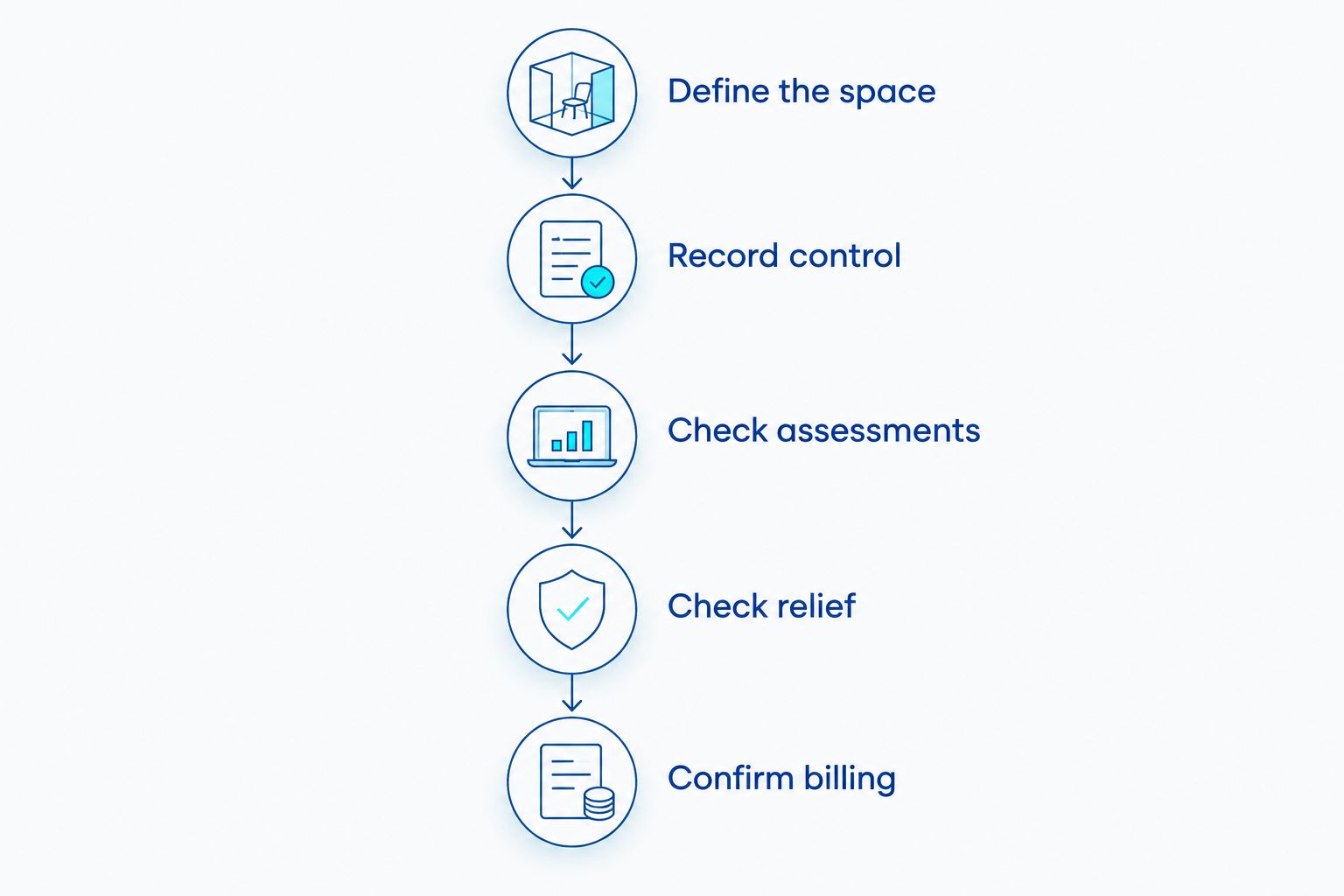
Resolve the occupation and billing questions before relying on subletting income to offset your rates. Use this sequence to keep the agreement, rating records and council account aligned.
1. Define the space
Mark the area you intend to sublet and the area you will retain. Show shared entrances, corridors, toilets, storage and any access through another occupier's accommodation.
Use a plan that reflects the actual layout. A property title plan alone need not show the internal boundaries relevant to a rating split.
2. Record control
Explain who holds keys, controls access and decides how each area is used. Record whether you retain rights to move the subtenant or use its accommodation.
Describe the arrangement accurately rather than selecting wording solely to obtain a preferred rates outcome. The facts must support the application.
3. Check assessments
Compare the existing rating-list entry with the proposed occupation. Establish whether the enquiry concerns a property split, an incorrect valuation, a council liability decision or more than one issue.
For a change taking place in 2026, check the applicable rating list and effective date. Do not assume an amendment to one period resolves every other period.
4. Check relief
Review relief for your retained premises and the subtenant's accommodation separately. Include other properties occupied by the relevant business where the scheme requires that information.
A split is not an automatic route to small business rate relief. Eligibility depends on the applicable rules and the ratepayer's circumstances.
5. Confirm billing
Give the council clear occupation details and ask how it will treat the accounts. Separately, make sure the agreement explains contributions, adjustments and responsibility for bills relating to different periods.
Do not stop paying an existing demand merely because you have requested a split. Seek written instructions from the council about the amount payable while the matter is considered.
Who handles the assessment and who handles the bill?
The valuation authority handles rating-list matters, including whether the assessment accurately reflects the property. The local council handles business rates billing, liability and relief administration. A valuation enquiry and a billing dispute are not interchangeable.
In England and Wales, current valuation challenges use Check, Challenge, Appeal. This has 3 stages: Check addresses the property facts, Challenge sets out the valuation dispute, and Appeal takes an unresolved eligible dispute to the relevant tribunal.
Checks and Challenges go to the valuation authority in both countries. Appeals go to the relevant Valuation Tribunal for England or Wales; this shared process does not mean every relief rule, deadline or tribunal arrangement is identical.
For a 2026 subletting case, identify the disputed decision before choosing a route. An argument about who occupied the premises needs different evidence from an argument about the property's rateable value.
What evidence should you keep?
Keep a file that lets someone understand both the physical space and the occupation history without reconstructing events from emails. Evidence is most useful when the dates, plans and agreements agree.
Include:
- The headlease and signed sublease or licence, including plans and schedules.
- A marked internal plan showing retained, sublet and shared areas.
- Dated photographs of boundaries, entrances and relevant alterations.
- A timeline distinguishing access, fitting-out and business occupation.
- The existing rating-list details and council demands for the disputed periods.
- Correspondence about occupation, assessment changes and relief decisions.
Keep the original documents as well as any summary. If the agreement describes one arrangement but the businesses operate differently, explain the difference rather than leaving the discrepancy unresolved.
For an ongoing arrangement in 2026, record later changes too. Taking back a room or changing access rights can make an earlier plan an unreliable description of current occupation.
Will subletting part of my premises reduce my bill?
Subletting does not guarantee a reduction in your business rates bill. A separate assessment can change your liability, but the retained property's valuation and relief position still need checking.
Compare the complete outcome, not just the reduction shown against the original assessment. The subtenant's liability and your contractual commitments also affect whether the arrangement achieves what you intended.
Can my subtenant pay me rather than the council?
A subtenant can agree to reimburse you or contribute towards rates, but that agreement does not decide statutory liability. The council bills the liable ratepayer according to the relevant facts and law.
Make clear whether payments relate to your existing bill or the subtenant's separately assessed accommodation. Address later adjustments expressly so that a revised demand does not create an avoidable contractual dispute.
Should I get advice before requesting a property split?
Get advice before requesting a split if you cannot establish the occupation boundaries, likely assessment treatment or relief consequences. Appeal My Rates UK is best suited to business owners seeking rating-surveyor help with property splits and council disputes.
The benefit is help identifying the rating issue and presenting the relevant evidence. The limitation is that representation does not guarantee a reduction, and professional fees must be considered alongside the scope of work.
Appeal My Rates UK fee basis — seller information: Most of our work is no win, no fee, but some instructions carry fixed fees. Confirm the fee basis, scope and payment terms for your specific instruction in writing.
Let us handle your case
Discuss your occupation, property split and council billing questions.
FAQ
Does signing a sublease automatically split my business rates?
Signing a sublease does not automatically split your business rates assessment. The valuation authority must consider whether the occupation and property facts justify separate entries.
Who pays business rates on a sublet office?
The liable ratepayer depends on the occupation and assessment facts, not simply the name on the headlease. A subtenant independently occupying separately assessed accommodation can have its own liability.
Can I divide my existing business rates bill by floor area?
Dividing your bill by floor area does not establish the correct rating assessment or council liability. You can agree a contribution privately, but that calculation does not bind the council.
Will my subtenant automatically get small business rate relief?
Your subtenant does not automatically get small business rate relief. Eligibility requires a separate check against the relevant scheme and the business’s circumstances.
Do England and Wales use different valuation challenge processes?
England and Wales both use Check, Challenge, Appeal for current rating-list valuation challenges. Checks and Challenges go to the valuation authority, while appeals go to the relevant tribunal for each country.
Should I keep paying while the council considers the subletting?
Do not stop paying an existing demand simply because a subletting enquiry or assessment request is pending. Ask the council to confirm in writing what remains payable.
Is rating-surveyor help always no win, no fee?
Most of our work is no win, no fee, but some instructions carry fixed fees. Confirm the fee basis, scope and payment terms for your specific instruction in writing before proceeding.
One last thing
Agree how later bill adjustments will be shared before the subtenant moves in. A clear occupation plan helps establish the rating facts, but it does not answer who reimburses whom after a revised demand. Put that arrangement in writing while both businesses are agreeing the terms.
Related guides
- Land Registry plans for a business rates property split
- Can I appeal business rates as a tenant, not the owner?
- Partly empty property and business rates appeals
- How to challenge a backdated business rates bill
