

Your business rates appeal cost depends on the fee basis, the work covered and the payment terms agreed for your instruction; there is no single figure that answers every case. Before appointing a surveyor in 2026, ask whether the agreement covers only the valuation challenge or also later representation, and confirm how any fee becomes payable.
- Business rates appeal cost depends on the written fee basis, scope and payment terms—not the headline promise.
- Appeal My Rates UK handles business rates appeals for business owners in England and Wales.
- Most of our work is no win, no fee, but some instructions carry fixed fees.
- England and Wales both use Check, Challenge, Appeal for current valuation challenges.
Why this matters
A quote is only useful when you know what it buys. An instruction to review a valuation is not automatically an instruction to prepare a Challenge, handle a council billing dispute or represent you at a tribunal.
Compare the written scope before comparing fee descriptions. Use the guide to business rates consultant fee terms to identify the questions to settle before you sign.
Your decision should separate the merits of challenging the valuation from the commercial terms of appointing someone. A fee arrangement does not establish that your assessment is wrong, and a promising valuation argument does not tell you when an invoice becomes due.
How much does a business rates appeal cost?
A business rates appeal needs an instruction-specific quote, not an assumed standard charge. For a 2026 instruction, the useful breakdown is the fee basis, the work included, the event that triggers payment and any work expressly excluded.
The following table compares fee arrangements rather than quoted amounts. Neither arrangement guarantees a reduction in your bill.
| Fee arrangement | Best for | Advantage | Limitation | Confirm in writing |
|---|---|---|---|---|
| No win, no fee | Owners who want the agreed fee linked to a defined successful outcome | Connects the fee obligation to the contractual definition of success | The meaning of success and the payment trigger still need checking | What counts as a win, how the fee is calculated and when payment falls due |
| Fixed fee | Owners who want an agreed charge for a clearly defined instruction | Makes the charge for the stated work clear | Work outside the agreed scope needs separate consideration | Deliverables, exclusions, payment timing and the terms if the instruction changes |
Do not treat “no win, no fee” as a substitute for reading the agreement. Equally, do not assume that a fixed fee covers every possible stage. Both descriptions need a written explanation tied to your property and the work you are authorising.
Ask whether the quoted fee includes applicable VAT, expenses and any separately charged work. These are questions for the agreement, not assumptions that every instruction carries extra charges.
No win, no fee: define the outcome first
The central question is what the agreement means by a successful result. Ask whether the fee relates to a valuation change, a reduction in liability, a refund or another specifically defined outcome.
These are not interchangeable descriptions. A change to rateable value and the amount ultimately shown on a council account are different things, so the fee calculation needs a clear basis.
Before accepting this arrangement, ask:
- What precisely counts as success under this instruction?
- How will the result used for the fee calculation be evidenced?
- Which property and rating-list period does the agreement cover?
- When does the obligation to pay arise?
- What happens if you withdraw the instruction or change representative?
Best for: business owners who understand the agreed outcome and want the fee linked to it. The limitation is that the label alone tells you neither the calculation nor the payment date.
Fixed fees: define the deliverable first
A fixed-fee instruction should identify the work being purchased. Ask for a description that lets you distinguish an initial assessment from preparing submissions, responding to questions or providing later representation.
The benefit is clarity about the charge for that defined work. The limitation is scope: a fixed charge for one task does not establish that a separate task is included.
Request written answers on what you will receive, what information you must supply and how additional work would be authorised. If the property circumstances change, ask for the scope to be reviewed before further work starts.
Best for: business owners who need a defined piece of work and want its charge agreed before instruction. Do not select it solely because the fee description sounds simpler; the deliverables still need to match the problem.
Why business rates appeal costs vary
The work needed for a valuation challenge is not identical to the work needed for a property split, merger or council dispute. These differences explain why the written instruction matters more than a generic fee label.
- Service required: establish whether you need valuation advice, a split or merger, or help with a council rates dispute.
- Stage covered: identify whether the instruction covers Check, Challenge, Appeal or a specified combination.
- Property scope: name the premises covered rather than assuming other properties fall within the agreement.
- Evidence required: establish what records you must provide and what evidence preparation the surveyor will undertake.
- Outcome definition: specify the result used to calculate a success-linked fee.
- Payment terms: confirm when payment is due and how changes to the instruction will be handled.
For your 2026 comparison, send each prospective adviser the same description of the property, issue and work required. Otherwise, you risk comparing different services under similar headings.
What work does Check, Challenge, Appeal involve?
England and Wales both use the 3-stage Check, Challenge, Appeal process for current valuation challenges. Checks and Challenges are handled by the valuation authority; appeals go to the relevant Valuation Tribunal for England or Wales.
The stages provide a practical way to define your instruction:
- Check: establish the property information and identify facts that need correcting.
- Challenge: set out the grounds and supporting evidence for disputing the valuation.
- Appeal: take an eligible unresolved dispute to the relevant Valuation Tribunal under the applicable rules.
A quote should identify which of these stages it covers. Do not assume that appointing someone at Check automatically includes tribunal representation.
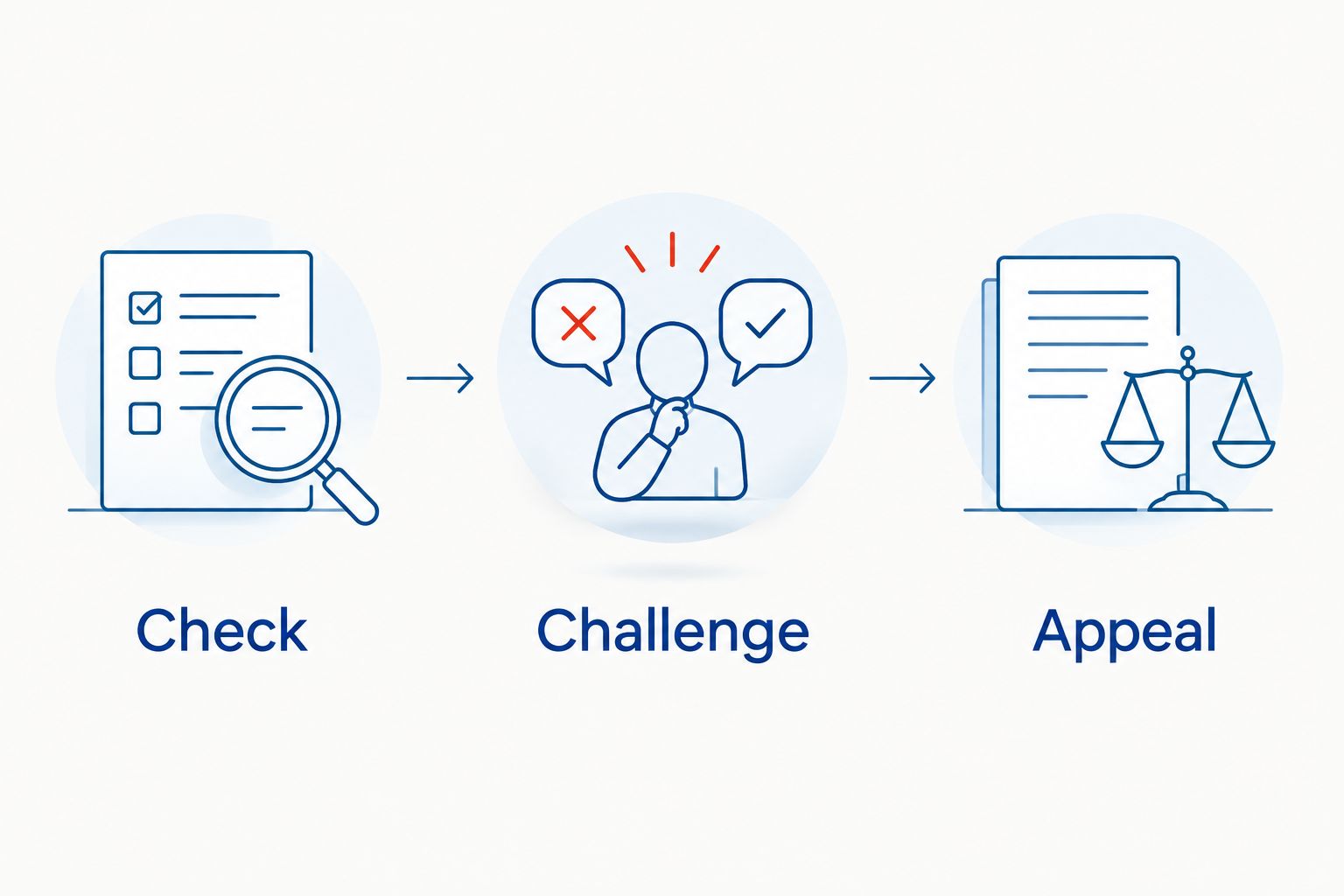
A shared process does not mean every deadline, relief, billing rule or tribunal arrangement is identical across England and Wales. For a 2026 instruction, ask the adviser to identify the applicable rating list and procedural requirements for your property.
Also separate the valuation dispute from the council account. If your concern is the bill, payment allocation or a relief decision, explain that at the outset rather than assuming a valuation challenge addresses it.
What should a written quote include?
A useful quote lets you answer a simple question: “What am I authorising, and what will make payment due?” You should not need to reconstruct the answer from a sales conversation.
Property and issue
The instruction should identify the property and describe the problem being addressed. Record whether the concern is the valuation, the way premises are assessed following a split or merger, or a dispute with the council.
Include relevant correspondence and explain what outcome you are seeking. This gives the adviser a defined issue to assess rather than a general request to lower the bill.
Work and exclusions
Ask for the included stages and deliverables to be named. Where later representation is outside scope, establish how you would decide whether to commission it.
Check whether communication with the council forms part of the instruction. Valuation work and council account work should not be treated as interchangeable simply because both concern business rates.
Fee calculation and payment
Request the fee basis, calculation method and payment terms in writing. Where success determines payment, the agreement should make the relevant outcome understandable to you.
Ask how a revised instruction, withdrawal or change of representative affects the agreement. Resolve uncertainty before signing, not after work has started.
Responsibilities and updates
Agree what records you need to supply and who handles correspondence. Keep the instruction, supporting documents and decisions together so you can follow the case without relying on memory.
Ask how you will be told about a decision requiring your approval. Clear responsibilities help you distinguish advice you have received from action you have authorised.
Is paying a surveyor worthwhile for your case?
The right starting point is evidence, not a promised saving. Ask what is said to be wrong with the assessment, which documents support that position and what work is needed to put the case forward.
Appeal My Rates UK is suited to business owners seeking professional rating surveyor help with valuation challenges in England and Wales. Its services also cover property splits, mergers and disputes with local council rates teams; your written instruction should specify which service you need.
The benefit of appointing a representative is having someone handle the agreed work for you. The trade-off is accepting contractual obligations, supplying the necessary information and paying according to the agreed terms; representation is not a guarantee of a reduction.
Judge the proposed instruction against the problem it addresses. A detailed explanation of the grounds and scope is more useful than an unsupported assurance about the result.
What fee terms does Appeal My Rates UK use?
Fee position: Most of our work is no win, no fee, but some instructions carry fixed fees.
Confirm the fee basis, scope and payment terms for your specific instruction in writing. Do not assume that appeals, splits, mergers or council disputes automatically use a particular fee model.
If you want help, contact us with the property details, the issue and any relevant correspondence. Ask for the proposed work and terms to be explained before you decide whether to proceed.
Do England and Wales use different appeal processes?
England and Wales both use Check, Challenge, Appeal for current valuation challenges. The shared route does not justify assuming that every associated rule is the same.
For instructions considered in 2026, establish the relevant rating list, property location and stage already reached. Ask which body will handle the next step and whether that step falls within the quoted scope.
Does a successful valuation challenge mean the whole refund is yours?
A successful valuation challenge does not remove the need to settle an agreed professional fee. Check the contractual calculation and payment trigger before treating an anticipated refund as money available to spend.
Ask for a written explanation of how the outcome relates to the fee. Avoid relying on an informal description such as “a share of the saving” without understanding what saving means in that agreement.
FAQ
How do I find out my business rates appeal cost?
Request a written quote for your specific property and instruction. Confirm the fee basis, included work, exclusions and payment terms before appointing a representative.
Is Appeal My Rates UK always no win, no fee?
Most of our work is no win, no fee, but some instructions carry fixed fees. Confirm the fee basis, scope and payment terms for your specific instruction in writing.
Does no win, no fee mean I never pay anything upfront?
Do not assume that every instruction requires nothing upfront. Read the written payment terms and ask what becomes payable, and when, under your specific agreement.
Does a quote include tribunal representation?
Tribunal representation is included only if your agreed scope covers it. Ask which Check, Challenge, Appeal stages the instruction includes and how any further work would be authorised.
Is a fixed fee better than no win, no fee?
Neither fee basis is automatically better for every instruction. Compare the defined work, outcome conditions, exclusions and payment terms against what your case needs.
Do business rates appeals in Wales use Check, Challenge, Appeal?
Yes, current valuation challenges in Wales use Check, Challenge, Appeal, as they do in England. Checks and Challenges go to the valuation authority, while appeals go to the relevant Valuation Tribunal.
Should I compare quotes before choosing a business rates surveyor?
Compare written quotes for the same property, issue and scope of work. Similar fee labels do not establish that the advisers are offering the same service.
One last thing
Ask the adviser to explain what happens if the instruction ends without the outcome you hoped for. That question tests whether you understand the agreement beyond its headline fee description.
Keep the answer with the signed terms. Before authorising work in 2026, you should understand both the proposed case and your obligations if the result, scope or representative changes.
Related guides
- How much does a business rates surveyor charge?
- How much can I save by challenging my business rates?
- Can my business rates go up after an appeal?