

Yes, serviced office spaces are liable for business rates, but the liable party can be the operator or the business occupying an individual office, depending on the occupation and assessment. An agreement stating that rates are included explains your arrangement with the operator; it does not, by itself, determine who the council can legally bill.
- Serviced offices business rates depend on occupation and control, not simply whether your agreement is called a licence.
- A separately occupied office can have its own rating assessment, even with shared reception and meeting rooms.
- Rates-inclusive payments do not automatically remove your legal liability to the council.
- Appeal My Rates UK provides business rates representation for occupiers and operators facing valuation or council disputes.
Why this matters
A serviced office bundles premises and services into an arrangement that feels simpler than a conventional lease. Business rates still require a separate check. You need to distinguish the property's assessment, the person legally responsible and the contractual arrangement for paying the bill.
For your 2026 office agreement, start by checking the premises description and finding the rateable value and rating list entry. A building-wide entry and an entry for your individual suite raise different questions; neither should be read without checking how the space is occupied.
Are serviced office spaces liable for business rates?
Serviced offices are not exempt from business rates simply because they include furniture, utilities or reception services. The central question is who occupies the relevant property for rating purposes.
Rating occupation involves actual occupation, beneficial occupation, sufficient permanence and occupation that is exclusive for the occupier's particular purposes. Exclusive occupation does not necessarily mean nobody else can enter. An operator's access for cleaning or maintenance does not, alone, settle the issue.
The arrangements below illustrate why the answer changes between workspaces. They are not automatic liability decisions.
| Workspace arrangement | Best for | Practical advantage | Business rates limitation |
|---|---|---|---|
| Hot-desking without an allocated area | Shared, flexible use | No individually reserved office | You still need to confirm the operator's billing arrangement |
| Dedicated desk in a shared room | A regular workstation | Consistent working position | A reserved desk alone does not settle rating occupation |
| Private serviced office | A business needing its own room | Greater control over a defined space | Separate occupation and assessment need checking |
| Business centre operated as a whole | An operator managing shared premises | Central management of services | Individual occupiers' control can complicate the assessment |
The useful distinction is not serviced versus conventional. It is shared use versus occupation of an identifiable property, considered alongside the full facts.
Hot-desking: check the shared occupation arrangement
With genuine hot-desking, you use available workstations rather than occupy a room reserved for your business. That arrangement points towards the operator retaining occupation of the shared workspace, rather than each user occupying a separate office.
Check what happens in practice. A membership described as hot-desking tells you little if the business actually controls an enclosed area and excludes other users from it.
Ask whether business rates form part of the operator's charges and whether any separate council account exists for your business. Keep the written response with your membership agreement. Shared access is useful evidence, but it is not a substitute for checking the assessment.
Private serviced offices: check the individual suite
A private room occupied by your business needs closer attention. A lockable suite, continuing use and control over access are relevant facts, even where the operator supplies furniture, internet and cleaning.
Shared kitchens, reception areas and bookable meeting rooms do not automatically prevent your office from being assessed separately. Equally, the existence of a private door does not decide the case on its own.
For a private office occupied in 2026, compare the suite number, floor and physical boundaries across your agreement, the rating entry and the council account. Differences between those records need explaining before you assume the bill covers the correct premises.
Rates-inclusive agreements: separate payment from liability
A rates-inclusive agreement can place a contractual obligation on the operator to meet business rates. That is useful, but it answers a different question from who is legally liable to the council.
Read the clause itself, not just the sales description. Establish whether the operator pays a council account in its own name, pays an account naming your business, or reimburses you after payment.
Also check what happens if the assessment changes or the council issues a backdated demand. Do not assume the phrase all-inclusive resolves a later billing dispute. If the council names your business, send the demand to the operator promptly and obtain written clarification rather than leaving it unanswered.
Why serviced office business rates liability varies
The outcome depends on the occupation and records, rather than the workspace's marketing label. These factors deserve attention:
- Defined space: Is your business using an identifiable room or simply accessing shared facilities?
- Control: Who decides who uses the space, and can the operator genuinely allocate it to another business?
- Continuity: Does your business occupy the same space on an ongoing basis, rather than attend occasionally?
- Actual use: Do day-to-day arrangements match the licence, membership or lease?
- Assessment boundaries: Does the rating entry cover the whole building, a floor or an individual suite?
- Contractual terms: Who has agreed to pay, reimburse or account for business rates?
No single factor should be treated as a shortcut. For example, an operator's contractual right to relocate you needs to be considered alongside whether and how that right operates in practice.
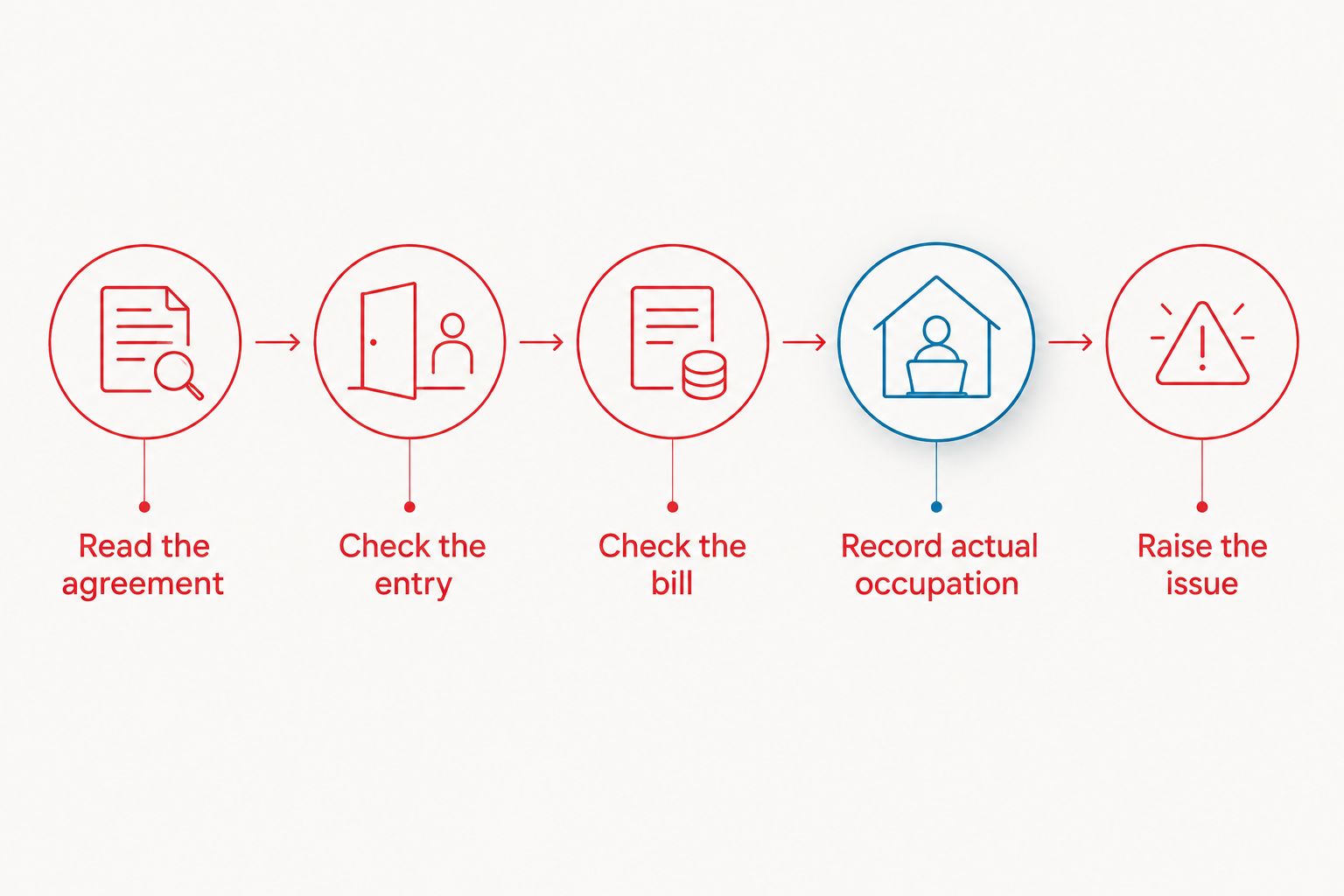
How do I check who should pay?
Use this sequence before signing an agreement or responding to a demand. Keep the documents together so the operator, council and any adviser are working from the same facts.
Read the agreement
Find the premises description and the clauses covering rates, shared services, relocation and access. Identify the legal entities named: the operator's trading name is not necessarily the company that contracted with you.
Ask for written clarification where the wording is unclear. A verbal assurance that everything is covered does not explain how the council account is managed or what happens if liability is disputed.
Check the rating entry
Match the listed property to the space you actually use. Check the address, suite description and assessment boundaries rather than relying on a postcode search alone.
A rateable value is not the amount you automatically pay. It is part of the calculation, with the applicable multiplier, reliefs and adjustments affecting the bill. Do not compare the rateable value directly with your monthly workspace payment.
Check the council bill
Confirm the named ratepayer, property description and dates. If your business moved between suites, make sure the account reflects the relevant occupation periods rather than treating the move as uninterrupted occupation of the same property.
A bill in the operator's name is relevant evidence, but it does not prove that the underlying position can never change. Likewise, a bill addressed to you is something to examine, not something to ignore because the operator promised to pay.
Record actual occupation
Keep floor plans, dated photographs, access arrangements, move-in correspondence and any relocation notices. Explain which areas your business controls and which remain shared.
For a 2026 occupation review, distinguish the date you signed from the date you obtained access and the date your actual use began. Those dates can answer different questions; avoid substituting one for another without explanation.
Raise the correct issue
Send liability, occupation-date and relief questions to the council's business rates team. Raise assessment boundaries, property facts and valuation issues with the valuation authority through the appropriate process.
A dispute can involve both bodies. State the correction you want from each rather than assuming a valuation challenge will automatically correct the council's account.
Can a serviced office occupier claim business rates relief?
A serviced office occupier can qualify for relief where the relevant scheme's conditions are met. Neither the serviced office label nor a small floor area creates an automatic entitlement.
First establish who is the ratepayer and what property is assessed. Then check the relevant council's current requirements, including any conditions concerning rateable value, occupation and other properties used by the business.
If the operator is the ratepayer for the wider assessment, do not assume you can claim relief personally against that same assessment. Ask how any relief affects the operator's charges under your agreement. A council award and a contractual reduction in your workspace payment are separate matters.
England and Wales have their own relief rules. For a 2026 claim, use the guidance applicable to the property's location rather than transferring an eligibility answer from another office elsewhere.
Can I challenge a serviced office assessment?
You can challenge an assessment where you have the required standing and grounds. Relevant issues include inaccurate property details, incorrect assessment boundaries or a valuation that is not supported by the evidence.
In England and Wales, current valuation challenges use Check, Challenge, Appeal. Checks and Challenges are handled by the valuation authority; appeals go to the relevant Valuation Tribunal for England or Wales. The shared process does not mean every deadline, relief or tribunal arrangement is identical.
For a 2026 case, identify the relevant rating list and effective dates before submitting evidence. An occupation dispute, a proposed property split and a disagreement about rental value require different explanations, even when they concern the same office.
A challenge is not a guaranteed reduction. Correcting property facts can leave the assessment unchanged or expose an undervaluation, so understand the grounds and risks before proceeding.
Does calling my agreement a licence avoid business rates?
A licence does not automatically remove business rates liability. The occupation facts matter more than the heading on the document.
A short or flexible agreement can still involve rateable occupation. Read the access and relocation clauses alongside actual use, and avoid relying on a statement that only leaseholders pay business rates.
Should I pay if the operator says rates are included?
Do not ignore a council demand because your agreement says rates are included. Ask the council to explain the account and ask the operator to confirm its contractual payment responsibility in writing.
A dispute does not automatically suspend collection. Keep paying amounts properly due unless the council confirms a different arrangement, and address any potential duplicate payment with supporting invoices and account records.
When is professional help useful?
Appeal My Rates UK is best for serviced office occupiers and operators who need business rates representation on valuations or council disputes. Its rating surveyor services also cover property splits and mergers, which are relevant where assessment boundaries no longer reflect occupation.
Professional representation does not guarantee a lower assessment or remove a genuine liability. It also creates a separate fee agreement, so understand the instruction before authorising work.
Most of our work is no win, no fee, but some instructions carry fixed fees. Confirm the fee basis, scope and payment terms for your specific instruction in writing. To discuss the documents and issue, contact the team.
FAQ
Do I pay business rates on a serviced office?
You can be liable for business rates on a serviced office if your occupation makes you the ratepayer. Check the actual occupation, rating assessment and council account rather than relying solely on the workspace agreement.
Are business rates included in serviced office rent?
Business rates are included only where your agreement provides for them. Inclusion explains the contractual payment arrangement, but does not by itself determine legal liability to the council.
Do hot-desk users need their own business rates account?
A genuine hot-desk user does not automatically need a separate business rates account simply because they use the premises. Shared access differs from occupying a defined office, and the assessment and occupation facts need checking.
Can my private office be assessed separately from the business centre?
A private office can be assessed separately where the occupation and property arrangements justify a separate assessment. Shared reception, kitchens or meeting rooms do not automatically prevent that outcome.
Can I get small business rates relief in a serviced office?
You can qualify for small business rates relief if you are the relevant ratepayer and meet the applicable scheme conditions. Check the property’s location, assessment and your other property interests with the council.
Is the business rates appeal process different in England and Wales?
Current valuation challenges in England and Wales both use Check, Challenge, Appeal. Checks and Challenges go to the valuation authority, while appeals go to the relevant Valuation Tribunal; other rules and arrangements still require location-specific checks.
Can Appeal My Rates UK handle a serviced office rates dispute?
Appeal My Rates UK provides business rates valuation and council dispute services for businesses in England and Wales. Most of our work is no win, no fee, but some instructions carry fixed fees. Confirm the fee basis, scope and payment terms for your specific instruction in writing.
One last thing
A rates-inclusive invoice and a council rates demand are not necessarily evidence that the council has billed twice. One records a contractual charge; the other records a statutory demand. Reconcile the operator's agreement, council account and payment records before deciding what needs correcting.
If you are taking a serviced office in 2026, ask for the rates arrangement in writing before you sign. Establish who is named on the account and what happens if that position changes.
Related guides
- Does moving to a coworking space change my business rates liability?
- Can I appeal business rates as a tenant, not the owner?
- Can I claim business rates relief and appeal at the same time?