
The small business rates relief threshold for full relief in 2026 is a rateable value of £12,000 in England and £6,000 in Wales, subject to eligibility. Relief ranges from 0% to 100%, tapering to zero at £15,000 in England and £12,000 in Wales; these are property valuation thresholds, not turnover limits.
- England’s small business rates relief threshold gives eligible properties 100% relief at rateable values up to £12,000.
- Wales gives eligible properties 100% relief at rateable values up to £6,000; relief reaches zero at £12,000.
- Rateable value is not your annual rates bill, rent payment or business turnover.
- Appeal My Rates UK provides rating surveyor services for valuation challenges and council rates disputes.
Why this matters
A property with a £12,000 rateable value sits at opposite ends of the standard relief scale in England and Wales. It attracts 100% small business rate relief in England if eligible, but 0% under the standard Welsh scheme.
Before using the table, find your rateable value and rating list. Use the assessment covering the period on your bill, rather than your rent or an older valuation.
Small business rate relief percentages by rateable value
Small business rate relief reduces eligible business rates liability. There is no meaningful average percentage for your property: its rateable value, location and eligibility determine the result.
| Rateable value | England: standard relief | Wales: standard relief |
|---|---|---|
| Overall standard range | 0%–100% | 0%–100% |
| £6,000 or below | 100% | 100% |
| £7,500 | 100% | 75% |
| £9,000 | 100% | 50% |
| £10,500 | 100% | 25% |
| £12,000 | 100% | 0% |
| £12,500 | 83.33% | 0% |
| £13,500 | 50% | 0% |
| £14,250 | 25% | 0% |
| £15,000 or above | 0% | 0% |
England provides the higher standard relief at £12,000 rateable value: 100%, compared with 0% in Wales. Both countries provide 100% relief at £6,000 or below, subject to their eligibility rules.
Sources and method: This 2026 reference table uses the standard thresholds described in GOV.UK’s Business rates relief: Small business rate relief guidance for England and Business Wales’ Small Business Rates Relief guidance for Wales. Intermediate percentages are calculated from the published linear tapers and rounded to two decimal places; the table does not establish individual entitlement or include other relief schemes, transitional arrangements or property-specific exceptions.
How to use these benchmarks
- Choose the country first. At £9,000 rateable value, the standard percentage is 100% in England and 50% in Wales.
- Check the exact assessment. England’s relief falls from 100% at £12,000 to zero at £15,000; a rounded estimate is not enough inside that band.
- Check eligibility separately. A percentage in the table is not approval, particularly where you occupy several properties.
- Compare the percentage with your bill. If your eligible English property has a £13,500 rateable value, the standard taper indicates 50% relief, not a 50% reduction in the rateable value itself.
England: full relief up to £12,000
For an eligible property in England, the standard small business rate relief position in 2026 is straightforward: 100% relief at a rateable value of £12,000 or below, then a sliding reduction until relief reaches zero at £15,000.
Inside the taper, calculate the percentage as follows:
Relief percentage = (£15,000 − rateable value) ÷ £3,000 × 100.
For example, a £13,500 rateable value gives 50% relief. A £12,500 rateable value gives approximately 83.33%, while £14,250 gives 25%.
The formula applies only within the taper band. Below it, eligible properties receive full relief; above it, the standard scheme provides none.
The advantage: qualifying properties retain full relief up to the higher English threshold. The limitation: the remaining relief falls as the assessment approaches £15,000, so being below that ceiling does not mean your bill disappears.
England’s usual eligibility position concerns businesses using one property, with additional-property exceptions. If you occupy another unit, disclose it to the council and ask for a written entitlement decision rather than assuming each property qualifies independently.
Wales: full relief up to £6,000
For eligible properties in Wales, the standard small business rate relief scheme gives 100% relief at rateable values of £6,000 or below. Relief then reduces on a sliding scale, reaching zero at £12,000.
Inside the Welsh taper, use this calculation:
Relief percentage = (£12,000 − rateable value) ÷ £6,000 × 100.
A £7,500 rateable value gives 75% relief. At £9,000, the percentage is 50%; at £10,500, it is 25%.
The advantage: the taper provides partial support above the full-relief threshold. The limitation: a property at £12,000 receives no standard small business rate relief, even though an eligible English property at the same assessment receives 100%.
Welsh entitlement also depends on scheme conditions, including restrictions affecting multiple properties. Ask the council to assess your full occupation position and property use; do not transfer an English eligibility decision to a Welsh property.
The thresholds here describe the standard scheme. They do not replace checks for any separate provision applying to your property type or circumstances.
Rateable value is not the amount you pay
Rateable value is a valuation used to calculate business rates. It is not your annual bill, and a £12,000 assessment does not mean you owe £12,000 in rates.
Your council calculates liability using the applicable multiplier and relevant adjustments, including reliefs. The table shows a relief percentage, not a payable balance or a forecast of savings.
Keep these figures separate when reviewing a 2026 demand:
- Rateable value: the property assessment used in the calculation.
- Gross liability: the calculated charge before the relevant relief adjustments.
- Relief awarded: the reduction recognised by the council.
- Balance payable: the amount the council requires after applicable adjustments.
A rateable value above the small business relief ceiling does not, by itself, prove that your bill is correct. Other reliefs, the multiplier, occupation dates and the assessment itself still require separate consideration.
Equally, a low assessment does not establish entitlement without the eligibility checks. Use the threshold to identify the question; use the council’s decision and calculation to establish the answer.
Check your entitlement before challenging the valuation
A missing relief award and an incorrect valuation are different problems. Start by identifying which part of the calculation you dispute, because sending valuation evidence to a billing team does not itself change the rating list.
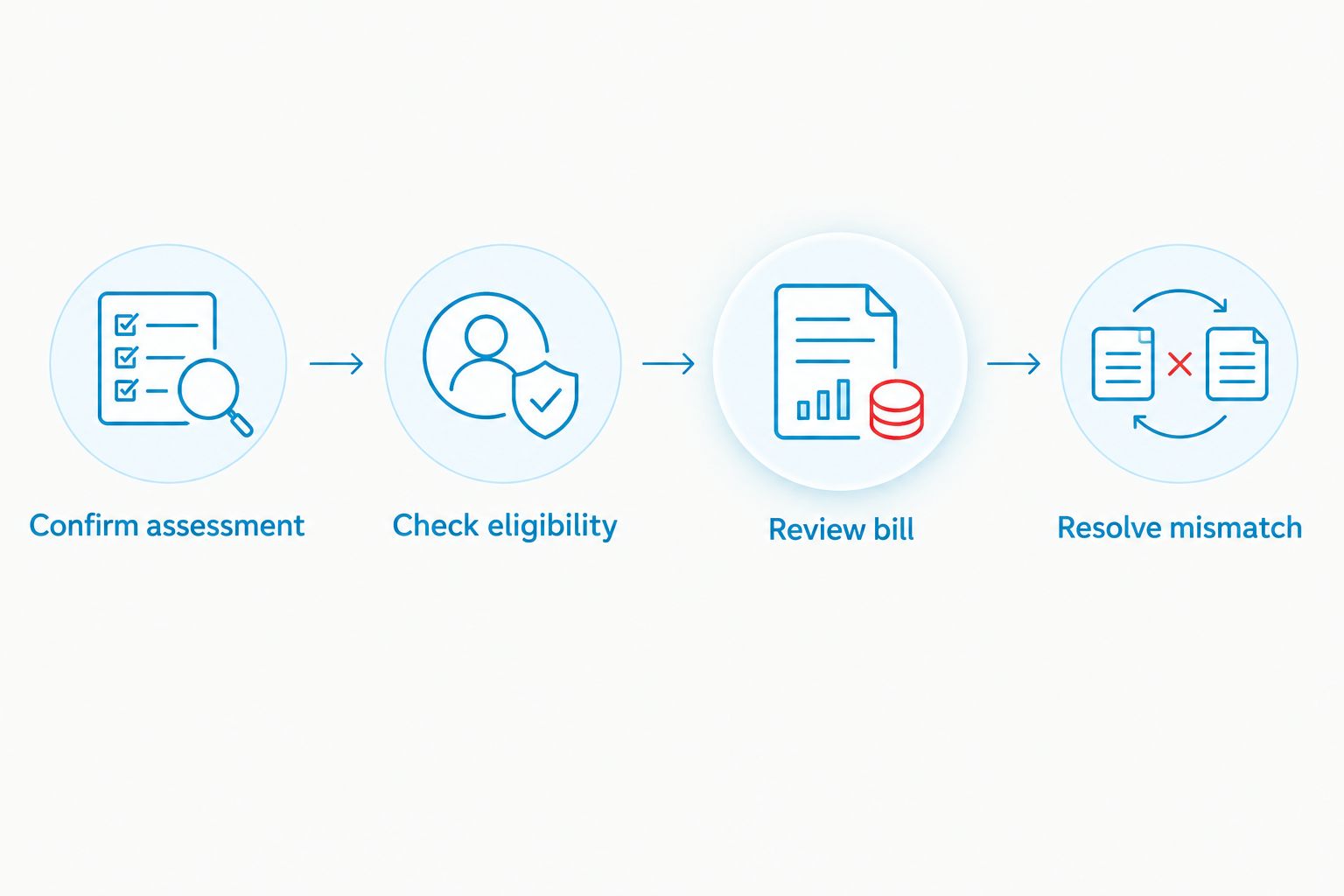
Confirm assessment
Match the property address, rateable value and effective period to your rates demand. If your premises have changed, make sure the assessment describes the property you actually occupy.
For a 2026 bill, check which liability dates the demand covers. Do not apply a current assessment indiscriminately to an earlier billing period.
Check eligibility
Tell the council about other business premises and explain how you use the property. Ask which scheme conditions it has applied, rather than relying only on the numerical threshold.
If the council refuses relief, request the reason in writing. A clear explanation lets you distinguish an eligibility issue from an administrative omission.
Review bill
Compare the awarded percentage with the correct country’s taper. Then check the dates over which the council applied it and whether the revised balance reflects the award.
Keep the demand notice, application, supporting evidence and decision together. This makes a disputed calculation easier to explain.
Resolve mismatch
Take a missing or incorrect relief award to the council. Take evidence of an incorrect rateable value through the valuation process, with advice where needed.
Appeal My Rates UK’s rating surveyor services suit business owners who need help with valuation challenges or council rates disputes. A straightforward relief application can instead begin directly with your council; professional representation is not a condition of applying.
Relief applications and valuation appeals are different
A relief application asks the council to apply a reduction to your liability. A valuation challenge disputes the property assessment used in calculating that liability.
| Route | Best for | Benefit | Limitation |
|---|---|---|---|
| Council relief application | An eligible property without the correct relief | Addresses entitlement and the relief award | Does not itself correct an inaccurate valuation |
| Valuation challenge | Evidence that the assessment is wrong | Addresses the underlying rateable value | Does not guarantee a reduction or establish relief eligibility |
| Council billing dispute | Incorrect dates, calculations or account treatment | Addresses the disputed demand | Does not replace the valuation challenge process |
For current valuation challenges in England and Wales, both countries use Check, Challenge, Appeal. Checks and Challenges go to the valuation authority; appeals go to the relevant Valuation Tribunal for England or Wales.
That shared process does not make the relief thresholds identical. It also does not establish identical billing rules, deadlines or tribunal arrangements.
Do not challenge a valuation solely because you want to cross a relief threshold. The assessment needs evidence-based grounds for correction, and a review does not guarantee a lower figure.
When professional help fits
Ask for help when you cannot reconcile the bill with the assessment, the council disputes entitlement, or property changes raise questions about the rating entry. Appeal My Rates UK handles valuation challenges, property splits and mergers, and disputes with council rates teams.
Professional support has a clear role in disputed cases, but it is not necessary for every relief application. If the assessment is accepted and the council simply needs your eligibility information, start with that request.
Most of our work is no win, no fee, but some instructions carry fixed fees. Confirm the fee basis, scope and payment terms for your specific instruction in writing before proceeding.
Let us handle your case if you need support with a valuation or council dispute. Explain the problem and provide the relevant demand notice and correspondence.
Ask us to review your case
Tell us whether your concern is the valuation, relief decision or council bill.
FAQ
What is the small business rates relief threshold in 2026?
For standard full relief, the rateable value threshold is £12,000 in England and £6,000 in Wales, subject to eligibility. Partial relief tapers to zero at £15,000 in England and £12,000 in Wales.
Do I get 100% relief with a £12,000 rateable value?
An eligible property at £12,000 rateable value receives 100% standard small business rate relief in England, but 0% under the standard Welsh scheme. Your council must also establish that you meet the relevant conditions.
How much relief applies at £13,500 rateable value?
An eligible English property at £13,500 rateable value receives 50% standard small business rate relief. A Welsh property at that assessment is above the standard scheme’s upper threshold.
Is the threshold based on turnover or profit?
The standard thresholds described here are based on rateable value, not turnover or profit. Other eligibility conditions still apply, including rules concerning additional properties.
Can I claim relief if I have more than one property?
Additional properties affect eligibility, so a low rateable value alone does not establish entitlement. Give the council details of every property you occupy and request a decision under the rules for the relevant country.
Do England and Wales use different valuation appeal processes?
Both England and Wales use Check, Challenge, Appeal for current valuation challenges. Checks and Challenges go to the valuation authority, while appeals go to the relevant Valuation Tribunal for England or Wales.
Do I need a surveyor to apply for small business rate relief?
No, you can approach your council directly about small business rate relief. Appeal My Rates UK provides rating surveyor services where you need help with a valuation challenge or council rates dispute.
One last thing
Check the relief line even when you accept the valuation. A correct rateable value and a correct relief award are separate checks; agreement with one does not settle the other.
For your 2026 review, keep the assessment, eligibility decision and final calculation together. Ask the council to explain any mismatch in writing before treating the bill as settled.
Related guides
- Claiming business rates relief while appealing
- How long small business rate relief approval takes
- Comparing business rates consultant fee terms