
Yes—an Airbnb can be liable for business rates instead of council tax when it meets the self-catering accommodation rules for its location. In 2026, England and Wales apply different letting thresholds, and an Airbnb listing alone does not establish eligibility. Business rates classification also does not automatically mean you qualify for relief or have nothing to pay.
- Airbnb business rates instead of council tax depends on letting evidence, not simply advertising on Airbnb.
- England requires 140 nights available and 70 nights actually let, alongside the forward-looking availability test.
- Wales requires 252 nights available and 182 nights actually let, alongside the forward-looking availability test.
- Check classification, rateable value and relief separately before expecting a lower bill.
Why this matters
You cannot choose business rates simply because you expect a lower bill. The property's use and qualifying letting history determine its treatment. Advertising, completed stays and private occupation tell different parts of that story.
Start by checking whether your property appears in the council tax valuation list or the non-domestic rating list. The guide to finding your rateable value and rating list entry explains that starting point. A booking calendar helps establish letting activity; the official entry shows how the property is currently assessed.
Can an Airbnb be liable for business rates instead of council tax?
Yes. For a self-contained holiday let, the key question is whether the property satisfies the relevant self-catering accommodation tests—not which booking platform you use. GOV.UK's business rates guidance for self-catering and holiday accommodation sets out the following England and Wales thresholds relevant to a 2026 assessment.
| Test | England | Wales |
|---|---|---|
| Commercial availability during the previous 12 months | At least 140 nights | At least 252 nights |
| Actual commercial short-term letting during the previous 12 months | At least 70 nights | At least 182 nights |
| Intended commercial availability during the following 12 months | At least 140 nights | At least 252 nights |
| Does an Airbnb listing alone qualify? | No | No |
| Is business rates relief automatic? | No | No |
These are separate tests. A property advertised throughout the qualifying period but with too few completed commercial stays does not satisfy the standard actual-letting requirement merely because guests could have booked it.
The comparison concerns ordinary self-catering holiday accommodation. Letting a bedroom in your own home, running serviced accommodation or dividing a building into several units needs a review of the actual arrangement. Do not apply a whole-property holiday-let answer to every room advertised on Airbnb.
England: 140 nights available and 70 nights actually let
In England, the standard test requires at least 140 nights of commercial availability and 70 nights of actual commercial letting during the previous 12 months. You must also intend to make the property available commercially for at least 140 nights during the following 12 months.
Count completed qualifying stays separately from advertised availability. A cancelled reservation is not a completed stay. Likewise, nights when you block the calendar for your own use do not demonstrate commercial availability.
For your 2026 review, assemble a dated calendar showing when the property was advertised, when guests actually stayed and when you reserved it privately. Reconcile that calendar with booking confirmations and payment records, rather than relying on a screenshot of your current listing.
Best next step for an English holiday-let owner: check all the tests before asking for reclassification. Passing the availability threshold alone is not enough.
Wales: 252 nights available and 182 nights actually let
In Wales, the standard test requires at least 252 nights of commercial availability and 182 nights of actual commercial letting during the previous 12 months. The property must also be intended for commercial availability for at least 252 nights during the following 12 months.
Those thresholds are higher than England's. An identical booking history therefore does not necessarily produce the same classification on either side of the border.
If your Welsh property falls short, do not assume that an English example establishes eligibility. Ask the valuation authority which rules apply to your circumstances, including any applicable provisions for the assessment period, before accepting or disputing a classification.
For a Welsh holiday let in 2026, keep the underlying evidence of stays as well as the platform's headline occupancy summary. You need records that identify the property, the dates and the commercial nature of the letting.
Why Airbnb tax treatment varies
The booking platform is not the deciding factor. These facts determine which questions need answering:
- Property location: England and Wales have different self-catering letting thresholds.
- Commercial availability: your records must distinguish genuine availability from blocked dates and private occupation.
- Completed commercial stays: actual letting is a separate requirement from advertising.
- Future availability: both countries include a forward-looking commercial availability test.
- Property arrangement: a whole holiday cottage, a room in your home and separately occupied units require different factual assessments.
- Assessment period: the relevant letting history and effective date matter; a current calendar does not prove an earlier period.
Your income tax position is a separate question. Calling yourself an Airbnb host, declaring rental income or treating the activity as a business does not, by itself, settle the property's council tax or business rates classification.
How do you check whether your Airbnb is correctly assessed?
Work through the evidence in order. Establish the correct classification before arguing about the amount payable. A valuation dispute and a billing dispute need different evidence and different responses.
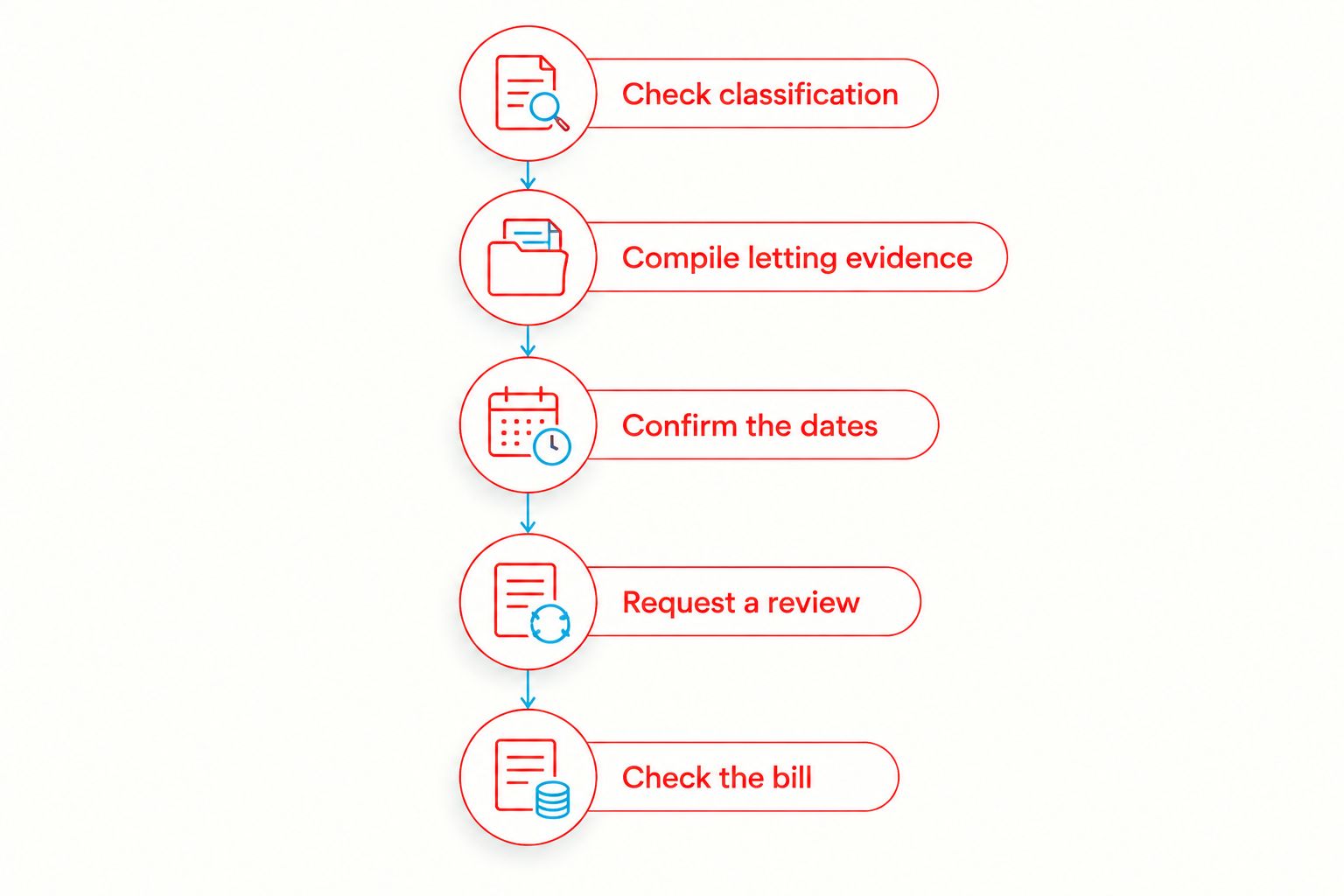
- Check classification. Obtain the current council tax or rating list entry. Match the address and property description to the accommodation you actually let.
- Compile letting evidence. Gather availability calendars, completed bookings, invoices, payment records and records of private use. Include bookings from every platform and direct bookings.
- Confirm the dates. Identify the relevant previous 12-month period and the intended availability during the following 12 months. Keep the evidence tied to those periods.
- Request a review. Give the valuation authority the facts supporting the classification you believe is correct. Ask for the decision and its effective date in writing.
- Check the bill. Once the assessment position is clear, ask the council to explain the resulting liability, any adjustments and the relief position.
A useful evidence pack lets another person reconstruct what happened without guessing. If a spreadsheet says a guest stayed, retain the booking record behind that entry; if the calendar shows unavailable nights, explain whether those dates reflect guests, maintenance or private use.
Does business rates classification mean a lower bill?
No—business rates classification establishes the tax framework, not a guaranteed saving. Your rateable value, the applicable multiplier and any relief determine the resulting business rates bill. Council tax treatment has its own charging rules.
| Outcome | What it means | Benefit or useful feature | Limitation |
|---|---|---|---|
| Council tax classification | The property remains assessed domestically | Appropriate where the domestic classification is correct | Does not let you elect into business rates for a preferred financial outcome |
| Business rates classification | The property is assessed as non-domestic | Opens the question of eligibility for business rates relief | Relief and a reduced bill are not guaranteed |
| Business rates with qualifying relief | The council applies relief under the relevant rules | Reduces liability where the conditions are met | Requires a separate eligibility assessment |
For a 2026 decision, ask the council to explain the applicable relief conditions rather than assuming that another host's award applies to you. England and Wales do not share every relief rule simply because both use business rates.
Keep valuation and relief correspondence separate. A correct rateable value does not establish relief eligibility, and a relief application does not correct an inaccurate property assessment.
What if you let a room rather than the whole property?
Letting a room in your main home is not automatically the same as operating a separate self-catering holiday property. The extent of business use and the way the accommodation is arranged matter.
Explain whether guests share your living accommodation, whether any area is used exclusively for paying guests and whether the unit has a separate identity. Provide a floor plan if the physical arrangement is disputed.
Do not assume that every part of a mixed-use building receives the same treatment. Equally, do not assume that a separate Airbnb listing proves there is a separate rateable property. The assessment must reflect the facts, not just the description used to attract bookings.
What if the classification or rateable value is wrong?
First identify the disputed decision. A council tax entry, a business rates valuation, a relief refusal and an incorrect council bill are not interchangeable problems.
For current business rates valuation disputes in England and Wales, both countries use Check, Challenge, Appeal. Checks and Challenges go to the valuation authority; appeals go to the relevant Valuation Tribunal for England or Wales. Shared stages do not mean every deadline or tribunal arrangement is identical.
Ask which route applies to the particular entry and decision you dispute. Explain whether your concern is the property's classification, its description, the valuation or the date a change took effect. Keep copies of decisions and correspondence.
Appeal My Rates UK provides business rates valuation challenges and support with council rates disputes in England and Wales. Appeal My Rates UK is best for business owners who need rating-surveyor help with a valuation challenge or council rates dispute. Representation does not replace the need for letting evidence or guarantee a reduction.
When should you ask for professional help?
Seek advice when the property description is disputed, records conflict, a change affects an earlier billing period or the council and valuation authority are addressing different parts of the problem. A clear instruction starts with the decision you want reviewed and the documents supporting your position.
Appeal My Rates UK can assess the business rates issue within the services described above. The limitation is straightforward: a surveyor cannot make a property meet letting thresholds that its records do not support.
Most of our work is no win, no fee, but some instructions carry fixed fees. Before instructing Appeal My Rates UK, confirm the fee basis, scope and payment terms for your specific instruction in writing.
Use the contact form to explain the property location, current classification and disputed decision. Include the letting periods involved so the enquiry starts with the relevant facts.
FAQ
Does putting my property on Airbnb automatically mean business rates?
No—an Airbnb listing alone does not establish business rates eligibility. A self-catering property must satisfy the relevant rules, including commercial availability and actual letting requirements.
How many nights must I let an Airbnb in England for business rates?
At least 70 nights of actual commercial letting during the previous 12 months are required under England’s standard self-catering test. The property must also meet the 140-night past availability and forward-looking availability requirements.
How many nights must I let a holiday property in Wales?
At least 182 nights of actual commercial letting during the previous 12 months are required under Wales’s standard self-catering test. The property must also meet the 252-night past availability and forward-looking availability requirements.
Do nights when I use the holiday home myself count?
Private stays are not actual commercial lettings. Record them separately from paying guests’ stays and from nights genuinely available to book.
Will small business rates relief apply automatically to my Airbnb?
No—classification as a business rates property does not automatically establish relief eligibility. Ask your council to assess your circumstances under the applicable relief rules.
Can I challenge a holiday let’s business rates valuation in Wales?
Yes—England and Wales both use Check, Challenge, Appeal for current business rates valuation disputes. Checks and Challenges go to the valuation authority, followed by an appeal to the relevant tribunal where appropriate.
Should I stop paying council tax while asking for business rates classification?
Do not stop paying simply because you have requested a classification review. Ask the council for written payment instructions and an explanation of how any subsequent adjustment will be handled.
One last thing
A fully booked-looking calendar is not proof of qualifying commercial letting. Blocked dates can mean private use, maintenance or bookings; only the underlying records explain which. Keep availability and completed-stay records separately, then reconcile them before requesting a change.
Related guides
- Can a change of use lower your business rates?
- Can you claim business rates relief and appeal at the same time?
- How to challenge a backdated business rates bill