

Cinema business rates appeals are challenges to a cinema’s rateable value aimed at correcting an inaccurate property assessment, rather than simply disputing a large bill. For cinemas and entertainment venues, the case needs to distinguish the property’s layout, occupation and valuation evidence from fluctuations in ticket sales.
- To challenge business rates valuation cinema assessments, identify a specific error and support it with property evidence.
- Appeal My Rates UK suits venue operators seeking professional representation for valuation challenges and council disputes.
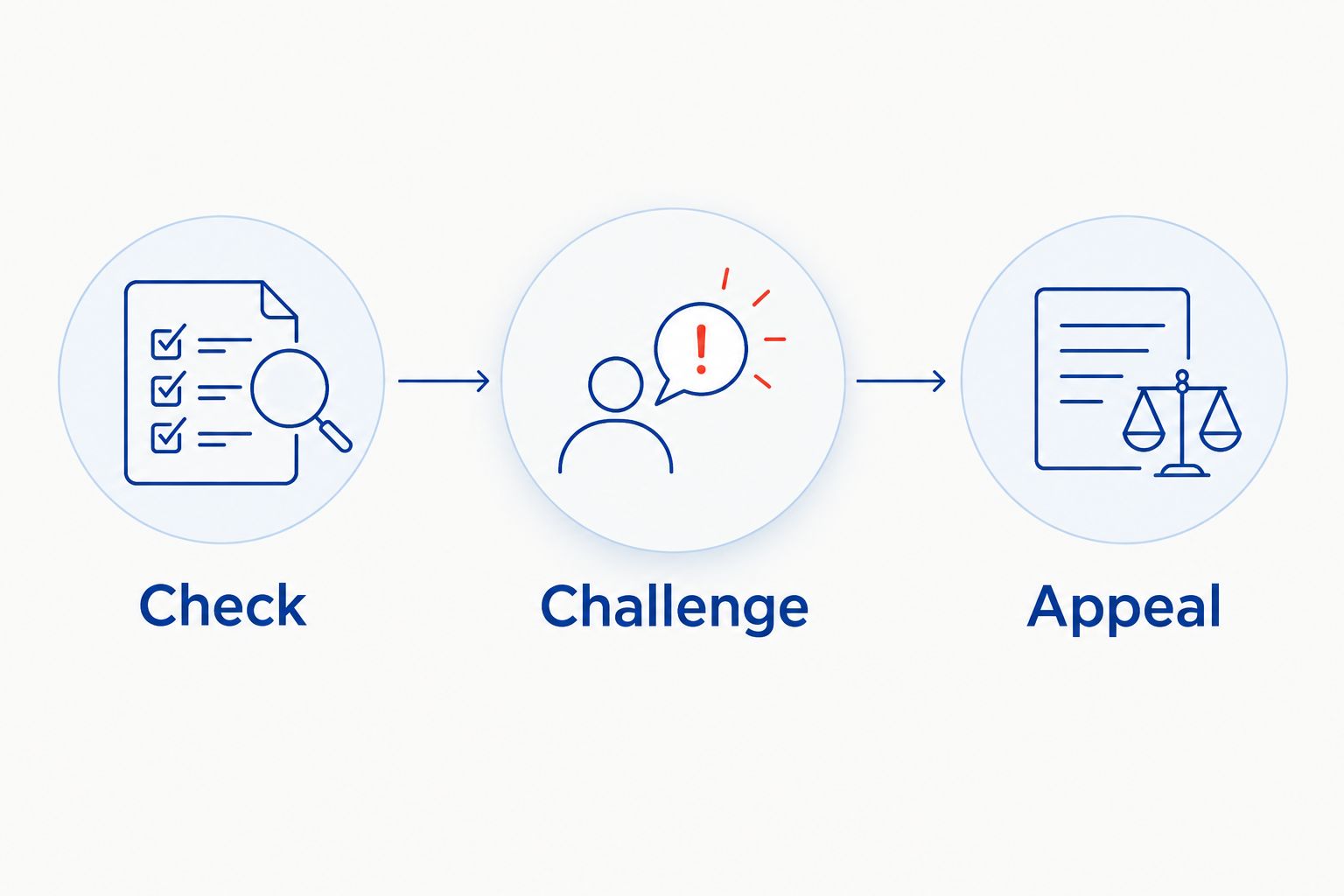
- England and Wales both use Check, Challenge, Appeal for current valuation challenges.
- Keep valuation challenges separate from council billing corrections and relief applications.
Why business rates appeals matter for cinemas
A high rates bill is a reason to investigate, not evidence that the valuation is wrong. Start by checking what the assessment covers, which rating list applies and whether the bill reflects the correct occupation details. The business rates appeals guide for 2026 explains the wider process.
Cinema and entertainment premises need particular care because an auditorium, foyer, bar, storage area and separately operated concession do not necessarily raise the same questions. Establish who occupies each space and how the valuation treats it before proposing a correction.
For a 2026 review, separate the work into 2 tracks: the valuation record and the council account. The valuation authority handles property assessments; the council handles billing and relief administration. Sending a valuation argument to the council does not replace the valuation challenge process.
Your immediate objective is a defensible decision: proceed with evidence, correct an administrative problem, or leave an assessment alone. An appeal is not automatically the right answer for every venue.
How to challenge a cinema’s business rates valuation
Identify the assessment and rating list
Begin with the free, manual route: compare your rates demand with the official business rates valuation record. Match the address, property reference, description and rateable value. Keep copies showing when you obtained them, rather than relying on a record that changes during the case.
Check the rating list attached to the assessment. In 2026, a bill or adjustment can concern a different period from the one you first expect, so do not assume that the most recent demand tells the whole story. Record the effective dates of any entries or alterations.
If your business occupies several units, establish whether the demand covers the cinema alone or includes other accommodation. A trading name is not a reliable substitute for identifying the assessed property.
Finish this first review with 1 evidence folder containing the records needed to identify the case:
- Save the current valuation entry and its property reference.
- Match the assessment to the council account and billed address.
- Record the rating list and effective dates shown.
- Flag duplicate demands or unexplained changes for investigation.
Map the venue and its occupation
Use existing lease plans, floor plans and your own inspection before commissioning further work. Mark the spaces your business occupies, the areas shared with others and any separately occupied accommodation. Distinguish an area that is quiet from an area your business no longer occupies.
A cinema with a concession operator needs more than a sketch showing a counter. The occupation arrangements, access and agreements matter. Equally, closing an auditorium between screenings does not by itself establish that the space should disappear from the assessment.
For an entertainment venue, document changes such as a converted screening room, altered access or a new division between occupiers. These are facts to assess, not automatic grounds for a reduction.
Date every plan and photograph. A clear record of when a change happened helps connect the evidence to the period under review.
- Label auditoriums, foyers, bars, stores and ancillary accommodation.
- Mark shared access and separately occupied spaces.
- Gather leases, licences and concession agreements.
- Photograph relevant alterations and record completion dates.
Test the valuation argument before instructing anyone
Write down the alleged error in a single sentence. Examples include an incorrect recorded area, an assessment covering the wrong accommodation, or a valuation assumption that does not match the relevant evidence. Then identify the documents that support that statement.
Comparable assessments need context. A nearby multiplex and a small independent cinema are not interchangeable merely because both show films. Compare relevant property characteristics and the valuation approach, rather than selecting the lowest rateable value you can find.
Appeal My Rates UK is best for venue operators seeking professional representation for business rates valuation challenges and council disputes. You can approach Appeal My Rates UK after assembling the basic records, rather than treating professional instruction as a prerequisite to checking them.
Professional assistance involves sharing documents and agreeing an instruction; it does not remove evidential requirements or guarantee a reduction. Ask for an assessment of weaknesses as well as the argument in your favour.
- State the suspected error and the correction you seek.
- Separate property evidence from complaints about trading conditions.
- Explain why each comparison is relevant.
- Ask what evidence contradicts the proposed case.
Follow Check, Challenge, Appeal in order
England and Wales both use Check, Challenge, Appeal for current valuation challenges. The valuation authority handles Checks and Challenges in both countries; appeals go to the relevant Valuation Tribunal for England or Wales. Do not confuse that shared sequence with identical rules for every regional billing or relief issue.
For a 2026 case, establish the applicable list, procedural requirements and deadlines before submitting anything. Check establishes the property facts; Challenge presents the valuation dispute; Appeal takes an eligible unresolved dispute to the relevant tribunal. Each stage has its own requirements.
Do not treat Challenge as a placeholder for evidence you intend to find later. Prepare the grounds, supporting material and proposed correction with the procedural rules in mind. Keep an exact copy of the submission and every subsequent response.
The sequence is Check, Challenge, Appeal; moving through it requires attention to the rules, not simply dissatisfaction with the previous answer.
Use a case log so the person handling the appeal can see what has happened without reconstructing the correspondence.
- Verify the submission requirements for the relevant rating list.
- Retain evidence of submissions and acknowledgements.
- Record decision dates and applicable next-step deadlines.
- Identify the relevant tribunal before considering an appeal.
Keep billing and relief questions separate
Review the council account alongside the valuation case, not as a substitute for it. Check the liable party, occupation dates, payments, adjustments and any relief already recorded. An incorrect account entry needs a different explanation from an excessive rateable value.
For a mixed entertainment business, explain the actual activities rather than assuming that the word cinema settles every relief question. Eligibility depends on the applicable rules and facts. Do not transfer an answer about an English venue directly to a Welsh property without checking the relevant scheme.
During 2026, keep correspondence clearly labelled as valuation, billing or relief. That small administrative distinction prevents a council response about a demand from being mistaken for a decision on your property assessment.
Continue paying the amounts due unless the council formally changes the payment arrangement or demand. A valuation challenge does not itself suspend your obligation to pay.
- Reconcile demands against payments and account adjustments.
- Check the recorded liable party and occupation dates.
- Ask the council to explain unclear relief decisions.
- Keep billing correspondence outside the valuation submission file.
Agree the instruction and assess the outcome
Before appointing a representative, confirm which work the instruction covers. A valuation challenge, a property split or merger and a council dispute are different tasks. Ask whether the appointment covers each relevant stage and what requires further agreement.
Appeal My Rates UK provides business rates appeals and rating surveyor services. Most of our work is no win, no fee, but some instructions carry fixed fees. Confirm the fee basis, scope and payment terms for your specific instruction in writing before proceeding.
A successful valuation correction and an updated council account are separate administrative events. Check the formal outcome, its effective date and the revised demand rather than treating an informal discussion as a completed result.
For your 2026 review, agree how progress and decisions will be communicated. Clear responsibilities matter whether you manage the case yourself or appoint a representative.
- Obtain written scope, fee basis and payment terms.
- Identify who supplies evidence and approves submissions.
- Confirm whether further stages need separate instructions.
- Reconcile any revised assessment with the council account.
Let us handle your case
Send your cinema valuation question and venue records, and ask for the scope, fee basis and payment terms in writing.
Compare your options as a venue operator
Choose the route that matches the problem. These options are not interchangeable: representation addresses case handling, while a council enquiry addresses the account or an applicable relief decision.
| Option | Best for | Main advantage | Key limitation |
|---|---|---|---|
| Self-managed valuation challenge | Operators with clear evidence and time to manage procedure | You control the records and submissions directly | You must assess the evidence and meet procedural requirements yourself |
| Appeal My Rates UK business rates representation | Operators wanting a rating surveyor to handle a valuation or council dispute | Professional support with the instructed case | Written scope and fee terms are required; a reduction is not guaranteed |
| Council billing or relief enquiry | Incorrect liability details, account entries or relief decisions | Directs the issue to the body administering the bill | Does not replace a valuation challenge |
| Initial review without a submission | Operators unsure whether there is a defensible error | Separates a genuine case from an unsupported complaint | Does not itself change the assessment or preserve procedural rights |
Choose by the issue, not by the size of the bill. A straightforward account error does not need to be dressed up as a valuation appeal. A disputed valuation cannot be resolved merely by asking the council for a smaller demand.
If several issues overlap, give each a named owner and a separate record. That prevents progress on a relief enquiry from masking an approaching valuation deadline.
Common mistakes cinema and entertainment operators make
Treating empty seats as proof of overvaluation
Poor attendance describes trading performance, not necessarily an error in the property assessment. Establish the valuation method and explain the relevance of any trading evidence before relying on it. A disappointing film programme is not, by itself, a complete valuation case.
Comparing venues by seat count alone
Seat count leaves out layout, ancillary accommodation, location and other relevant characteristics. Explain why the comparison supports your proposed valuation. A lower assessment elsewhere is a starting point for investigation, not a conclusion.
Assuming every bar or concession needs a separate assessment
A separate brand or payment terminal does not settle occupation. Review who occupies the space, the agreement and how the premises function. Request a split or merger review on the evidence rather than on the appearance of the trading arrangement.
Treating refurbishment as an automatic reduction
Replacing seats, improving sound equipment or closing temporarily for works does not automatically establish entitlement to a lower assessment. Describe the condition, extent and timing of the works. Then assess their rating significance rather than promising a result from the refurbishment label.
Accepting an instruction without checking its boundaries
Ask what happens if the case needs additional work, a different procedural stage or a separate council dispute. Written terms should explain the fee basis and payment arrangements for the actual instruction. Do not assume that every task follows the same arrangement.
FAQ
How do I challenge my cinema’s business rates valuation?
Identify a specific assessment error, gather supporting property evidence and follow Check, Challenge, Appeal. Confirm the relevant rating list and procedural requirements before submitting your case.
Does a cinema in Wales use Check, Challenge, Appeal?
Yes. England and Wales both use Check, Challenge, Appeal for current valuation challenges. Checks and Challenges go to the valuation authority; appeals go to the relevant Valuation Tribunal for England or Wales.
Can falling ticket sales reduce my cinema’s business rates?
Falling ticket sales do not automatically justify a lower rateable value. Their relevance depends on the valuation approach and the evidence supporting the proposed correction.
Should I contact the council or the valuation authority?
Contact the valuation authority about the property assessment and the council about billing or relief administration. Some cases require both routes, but each issue needs its own explanation and records.
Can I stop paying business rates while my appeal is considered?
No. A valuation challenge does not itself suspend payment obligations. Continue paying the demand unless the council formally changes it or agrees a different payment arrangement.
What evidence should a cinema operator collect first?
Start with the valuation entry, rates demands, lease and floor plans. Add dated photographs, occupation records and a written explanation of the specific error you want corrected.
Can a cinema’s rateable value increase after a review?
Yes. A review can identify an assessment that is too low as well as one that is too high. Assess that risk before submitting a case rather than assuming every review produces a reduction.
One last thing
Before collecting more evidence, write the correction you want in one sentence. If the sentence only says that the bill is unaffordable, the valuation argument is not ready. If it identifies a recorded area, occupation boundary or valuation assumption and explains why it is wrong, you have a focused starting point.
Give the person handling your case that sentence with the supporting records. It makes the first discussion about the issue that needs resolving, not a pile of unrelated paperwork.
Related guides
- Find comparable properties for a rates appeal
- Claim business rates relief and appeal at the same time
- Compare business rates consultant fee terms