

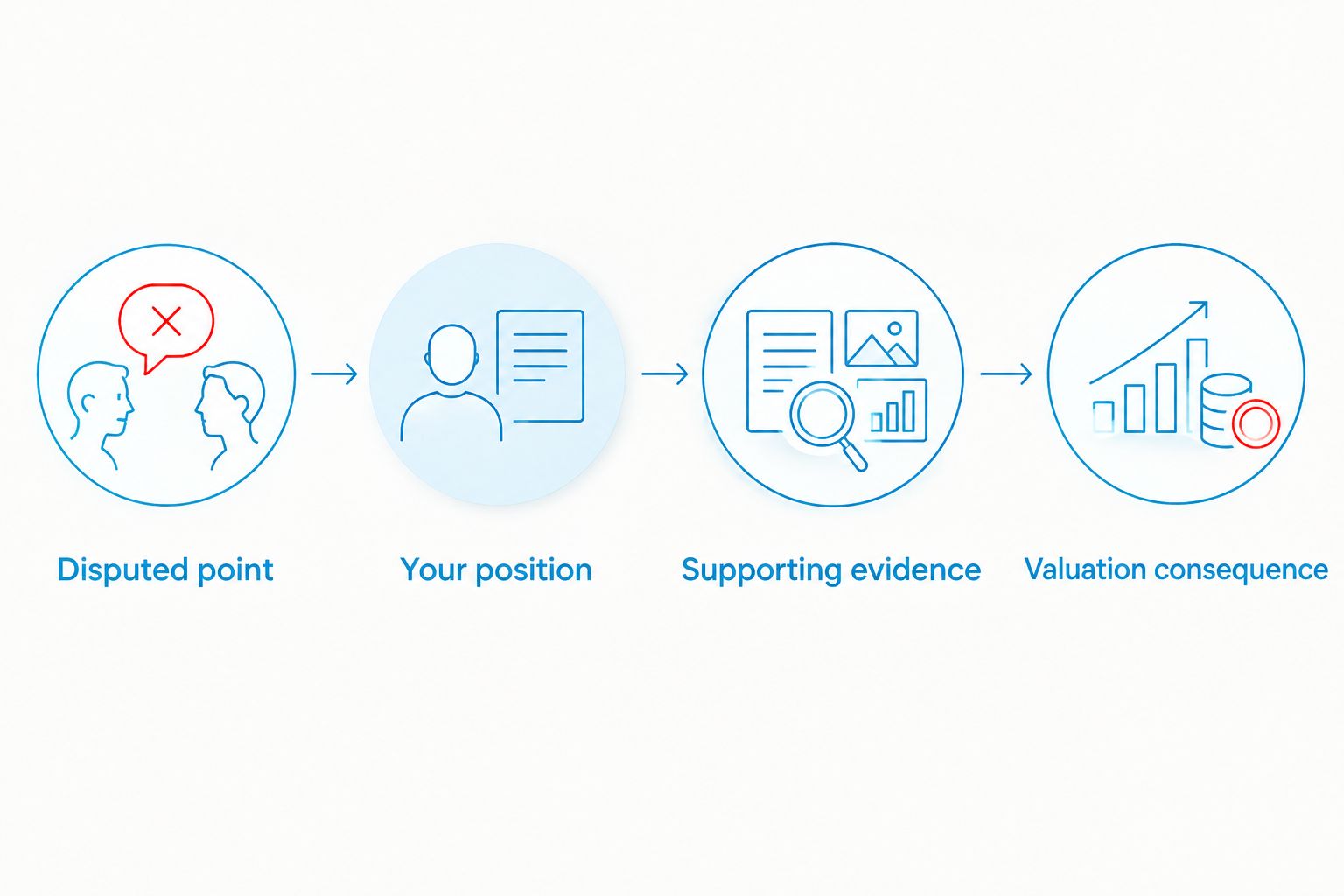
Instead of repeatedly rereading a VOA Summary of Reasons, build a business rates Challenge around each disputed point, the evidence supporting your position and the alteration you seek. This 2026 workflow turns the document into a structured submission without confusing a valuation dispute with a council billing problem.
- VOA summary of reasons business rates challenge preparation starts with the correct assessment, procedural stage and deadline.
- Answer disputed valuation points with relevant evidence, not a general objection to your business rates bill.
- Appeal My Rates UK handles business rates valuation challenges for business owners in England and Wales.
- Keep the submitted statement, attachments and acknowledgement together so you can verify exactly what was filed.
Why this matters
A Summary of Reasons explains the valuation authority’s position; it does not, by its title alone, establish your next procedural step. Read it alongside the covering correspondence, case reference and any Check or Challenge decision.
Your submission must explain why the assessment is wrong, not simply why the bill is difficult to pay. A lower turnover, a larger bill or a neighbouring business’s smaller payment does not establish the correct rateable value on its own.
In 2026, England and Wales both use Check, Challenge, Appeal for current valuation challenges. The Check, Challenge, Appeal guide explains the stages; this article focuses on turning reasons and supporting records into a case.
Appeal My Rates UK is best for business owners seeking professional help with business rates valuation challenges in England and Wales. Professional representation gives you support with the case, but it does not guarantee a reduction or remove your responsibility to provide accurate records.
Before you start
- Access and authority: have access to the relevant business rates valuation account and assessment, or confirm that your appointed representative has the necessary authority. Keep the property and case references available.
- Case materials: collect the Summary of Reasons, covering correspondence, Check outcome, valuation details and the documents supporting your objection. Include earlier submissions so you do not contradict your existing account.
- The procedural gotcha: establish whether you are preparing a Challenge, responding during an existing Challenge or considering an Appeal after a Challenge decision. Receiving reasons does not automatically create a fresh Challenge opportunity or restart a deadline.
Case register
- Create 1 case register. Record the property address, assessment reference, rating list, rateable value, case reference and person responsible for correspondence. Use a separate record for each assessment.
- Identify the document. Record its exact title, issue date, sender and stated purpose. Note whether it accompanies a decision or requests a response in an open case.
- Confirm your procedural stage. Read the latest formal correspondence and current official guidance together. If a Challenge decision has already been issued, do not prepare another Challenge as though the first one never happened.
- Record the deadline and its source. Copy the relevant date into your case register and retain the correspondence or guidance explaining it. Check any uncertainty before drafting the substantive argument.
- Check the assessment period. A submission prepared in 2026 must identify the rating list and period actually disputed. Do not assume the date on your latest council bill identifies the valuation issue.
Expected result: you can state which assessment you dispute, which stage you have reached and what action is required next. If those answers remain unclear, resolve them before assembling a lengthy evidence bundle.
Give one person responsibility for the case register. Shared responsibility without a named owner makes it harder to distinguish a draft response from the version actually submitted.
Reasons-to-evidence schedule
- Separate the disputed points. Copy a short extract or accurate summary of each material reason into a working schedule. Add the page or paragraph reference so another reader can find it.
- Record your position. Mark each point as agreed, disputed or requiring clarification. Do not contest an accurate fact merely because the overall valuation remains disputed.
- Sort documents into 3 evidence groups: property facts, valuation evidence and procedural records. This is a filing method, not a legal requirement.
- Match evidence to each objection. Identify the document, relevant page, date and fact it establishes. Explain the connection rather than expecting the caseworker to infer it.
- Record the valuation consequence. State how the disputed point affects the assessment. Where you propose an alteration, show the reasoning and calculation supporting it.
A document’s usefulness depends on what it proves. The following comparison helps you select evidence without treating every attachment as equally persuasive.
| Evidence type | Best for | Strength | Limitation |
|---|---|---|---|
| Measured plans and survey records | Disputed floor areas or layout | Connect dimensions to identifiable parts of the property | A plan alone does not establish the appropriate valuation rate |
| Lease and rental documents | Examining rental evidence | Show contractual terms and relevant dates | Headline rent needs context, including incentives and unusual terms |
| Comparable assessments | Testing valuation consistency | Allow property-by-property comparison | Similar addresses do not establish equivalent properties |
| Dated photographs | Showing an identifiable physical condition | Make the documented condition visible | Photographs alone do not establish the valuation effect or full history |
When using other properties, explain the differences as well as the similarities. The guide to finding comparable properties for a rates appeal helps you organise that comparison.
Expected result: each disputed reason has an evidence reference and an explanation of the alteration sought. An unsupported point remains a question to investigate, not an established fact to present.
Challenge statement
- Open with the assessment and requested alteration. Identify the property, rating list and case reference. State the correction you seek and the basis for seeking it, without opening with your trading difficulties.
- Explain each ground separately. For every disputed point, set out the authority’s position, your response, the evidence reference and the effect on the valuation. Keep factual corrections separate from disagreements about valuation judgement.
- Show the working. If your case depends on area, rental analysis or a comparable assessment, explain how you move from the source information to the proposed result. Do not submit a replacement figure without its basis.
- Address contrary evidence. Explain why a document or comparison relied on in the Summary of Reasons does not resolve your objection. Acknowledge any part that you accept.
- List the attachments. Give every document a distinct, descriptive filename and identify the pages supporting your argument. Remove duplicate copies unless an annotation or revision matters.
Use this drafting pattern for each ground: disputed reason; correction sought; supporting evidence; valuation effect. These are suggested document headings, not online service buttons or compulsory form labels.
Keep observation and interpretation separate. A plan showing a room’s dimensions is evidence of dimensions; the argument about how that room should be valued needs its own explanation.
Expected result: a reader can follow the route from the disputed assessment to your proposed alteration without searching through unrelated attachments. The statement explains both what you want changed and why the evidence supports it.
Submission record
- Complete 2 review passes. First check factual consistency: names, addresses, dates, areas, references and calculations. Then check procedural completeness against the current requirements for your case.
- Reconcile the statement and attachments. Open every file you intend to submit. Confirm that the cited page exists, the document is readable and the final version matches the filename in your index.
- Use the correct submission route. Follow the current official instructions for the relevant case stage. Do not assume an ordinary email or an attachment sent to the council constitutes a valid valuation Challenge.
- Retain the submitted version. Save the completed statement, attachments, submission date and any receipt or acknowledgement. Where the service provides a reference, add it to the case register.
- Record the next action. Note any response requested and allocate responsibility for monitoring correspondence. Keep later exchanges with the original submission rather than in an unconnected inbox folder.
For a 2026 submission, verify the live service instructions rather than copying an old screenshot or another ratepayer’s experience. Form wording and document requirements must come from the service you are actually using.
Expected result: your records show what was submitted, when it was submitted and how receipt was recorded. A saved draft is not evidence of submission.
Updated reasons during an existing Challenge
If the authority supplies further reasons while your Challenge remains open, update the existing evidence schedule rather than automatically starting a new case. First establish what the correspondence asks you to do.
- Identify the change: distinguish a new valuation argument from a restatement of an earlier position.
- Preserve the original: keep the previous reasons and your submitted response so the sequence remains clear.
- Update the affected ground: explain whether the new information changes your position, supporting documents or proposed alteration.
- Check the response route: use the channel and deadline applicable to that correspondence.
Best for: an ongoing Challenge where further explanation or evidence has been requested. This approach keeps the dispute focused, but it is not a substitute for an Appeal where a Challenge decision has already moved the case to that stage.
If the disagreement concerns council billing, relief or payment allocation instead, separate it from the valuation argument. Correcting one record does not automatically resolve the other.
Troubleshooting
The reasons concern the wrong assessment or period
Compare the property reference, rating list and effective period across the reasons, decision and your evidence. Ask for clarification of any mismatch before using the document as the basis of your response; keep the relevant deadline under review while doing so.
Your objection is that a neighbour pays less
Compare assessments and property characteristics, not just final bills. Relief, occupation and other billing factors affect what a business pays, so a smaller bill is not a like-for-like valuation comparison.
The bundle contains strong documents but no argument
Add a short explanation beside each material evidence reference. State which reason it answers and how it supports the alteration sought; an unexplained collection of leases, photographs and plans leaves that work to the reader.
The Summary of Reasons arrived with a Challenge decision
Read the decision and the applicable Appeal guidance before taking further action. Checks and Challenges are handled by the valuation authority; appeals go to the relevant Valuation Tribunal for England or Wales.
You cannot find proof of submission
Check the case record, acknowledgements and messages held by your representative. Do not assume that uploading a file completed the process; establish the recorded status through the official service and resolve uncertainty promptly.
Customise your workflow
For multiple properties, use the same document structure but retain assessment-specific arguments and evidence. A common lease format or shared occupier does not make every valuation dispute identical.
If you want Appeal My Rates UK to handle your business rates Challenge, provide the reasons, decision correspondence and supporting property records together. This gives the surveyor the context needed to assess the instruction rather than an isolated objection.
Most of our work is no win, no fee, but some instructions carry fixed fees. Confirm the fee basis, scope and payment terms for your specific instruction in writing, including whether any later tribunal work falls within that scope.
Let us handle your case
Send the reasons and case correspondence, and confirm the scope and fee terms in writing.
FAQ
How do I turn a VOA Summary of Reasons into a business rates Challenge?
Identify each disputed reason, match it to relevant evidence and explain the alteration you seek. Confirm the assessment, procedural stage and deadline before drafting.
Does receiving a Summary of Reasons restart my Challenge deadline?
Do not treat receipt of a Summary of Reasons as restarting a deadline. Read the covering correspondence and applicable official guidance to establish the action and time limit for your case.
Does Check, Challenge, Appeal apply in Wales in 2026?
Yes. England and Wales both use Check, Challenge, Appeal for current valuation challenges; this does not mean every billing rule, relief or tribunal arrangement is identical.
What evidence should I attach to a business rates Challenge?
Attach evidence that directly supports your stated grounds, such as relevant survey records, rental documents or analysed comparable assessments. Explain what each document proves and its effect on your proposed valuation.
Can I stop paying business rates while challenging the valuation?
A valuation Challenge does not suspend your business rates payment obligations. Continue paying the bill as required and discuss payment difficulties separately with the council.
What if I have already received a Challenge decision?
Check the available Appeal route rather than assuming another Challenge is the next step. Appeals go to the relevant Valuation Tribunal for England or Wales, subject to the applicable requirements.
Can Appeal My Rates UK help prepare my Challenge?
Yes. Appeal My Rates UK provides business rates appeals and rating surveyor services in England and Wales. Most of our work is no win, no fee, but some instructions carry fixed fees. Confirm the scope, fee basis and payment terms for your instruction in writing.
One last thing
Before submitting in 2026, ask someone unfamiliar with the case to read one disputed ground and find its supporting evidence. If they cannot identify the requested correction and follow the reasoning, improve the explanation before adding more documents.
Related guides
- Use your VOA account to challenge a business rates valuation
- Compare business rates consultant fee terms
- Track your business rates appeal case status