

A rent review does not automatically change your business rates valuation: the agreed rent is evidence, not a replacement for your rateable value. Its relevance depends on the rental market at the rating list’s valuation date, your lease terms and the property being assessed. Even if your rateable value changes, your council bill also depends on the applicable multiplier, reliefs and other billing adjustments.
- A rent review business rates valuation change is not automatic; contractual rent and rateable value serve different purposes.
- Compare rental evidence at the rating list’s valuation date, not just the date you agreed the rent.
- England and Wales both use Check, Challenge, Appeal for current valuation disputes.
- Appeal My Rates UK helps business owners challenge valuations; a rent review alone does not establish an appeal case.
How does a rent review affect my business rates valuation?
Your reviewed rent can support a valuation argument, but it does not dictate the answer. A rent review determines what you pay under your lease. A rating valuation applies statutory assumptions to assess the property for business rates.
Start by checking the property details, valuation basis and relevant rental evidence. The guide to business rates checks and appeal evidence explains how to organise that starting point.
| Issue | Lease rent review | Business rates valuation |
|---|---|---|
| Purpose | Sets rent payable under your lease | Establishes the property’s rateable value |
| Relevant date | The review date specified by the lease | The valuation date for the relevant rating list |
| Terms considered | Your actual rent review clause and lease terms | Statutory rating assumptions and relevant evidence |
| Main strength | Records a rental outcome for the actual premises | Assesses the property on the required rating basis |
| Main limitation | Contractual restrictions can affect the outcome | It is not a calculation of your individual council bill |
| Best for | Understanding your landlord’s rent demand | Assessing whether your rating valuation is correct |
For a case considered in 2026, identify the rating list before comparing figures. A recent rent review and a current rateable value are not necessarily valuations of the same thing at the same date.
Why this matters
A higher rent creates an immediate concern: will business rates rise as well? A lower rent creates the opposite expectation: should the council now reduce the bill?
Neither follows automatically. Treating the reviewed rent as a direct substitute for rateable value can lead you to challenge the wrong figure or expect savings that the evidence does not support.
The practical question is whether the review reveals a problem with the rating assessment. That requires more than comparing the two headline amounts. You need to understand what each figure includes, when it applies and how it was reached.
Which date matters for a rent review in 2026?
The 2026 rating list took effect on 1 April 2026. Its valuation date is separate from its commencement date: the rental market is assessed by reference to the relevant antecedent valuation date, rather than simply using today’s agreed rent.
This distinction matters when a review takes place after the market has changed. A later settlement needs analysis before it can support an argument about rental value at the rating list’s valuation date.
Keep these dates separate in your records:
- Review date: when the revised contractual rent takes effect.
- Agreement date: when the landlord and tenant settle the review.
- Valuation date: the market reference date for the rating list.
- Effective date: when a rating assessment or alteration applies.
A review agreed in 2026 can still concern an earlier contractual review date. The signed agreement should show which date the settlement relates to; the signature date alone does not answer that question.
If your dispute concerns an earlier bill, identify the list and period involved. Do not assume that a review of the current assessment resolves every historic charge.
What different rent review clauses tell you
The review clause affects the strength of the evidence. Before relying on an agreed rent, establish whether the lease tests the open market or applies a contractual formula.
| Review basis | What the outcome tells you | Strength | Limitation | Best for |
|---|---|---|---|---|
| Open-market review | A rental assessment under the lease’s stated assumptions | Can provide relevant rental evidence | Lease assumptions can differ from rating assumptions | Examining market rental evidence |
| Upward-only open-market review | The market assessment, subject to a contractual floor | Can show the reasoning behind an agreed increase | An unchanged rent does not prove an unchanged market | Checking whether a floor affected the result |
| Index-linked review | A rent adjustment linked to the specified index | Explains the contractual increase | Does not directly test comparable market rents | Understanding why the lease payment changed |
| Fixed or stepped increase | A change already specified in the lease | Makes the contractual progression clear | Does not demonstrate a fresh market valuation | Separating lease mechanics from valuation evidence |
An open-market review is not automatically equivalent to a rating valuation. Read the assumptions and disregards in the lease before drawing a conclusion. Those provisions determine what the review treats as part of the letting and what it leaves out.
For an upward-only review, an unchanged rent can reflect the contractual floor rather than the current open-market rental value. Ask for the valuation reasoning, not just the settlement letter.
Why the effect of a rent review varies
The weight given to reviewed rent depends on the evidence behind it. These factors explain why apparently similar rent settlements can have different relevance to a rating case:
- Timing: the review must be considered against the rating list’s valuation date.
- Review mechanism: an index adjustment or fixed increase does not test the market in the same way as an open-market review.
- Lease terms: repairing obligations, restrictions and other terms affect the comparison with the statutory rating basis.
- Rental package: incentives, service charges and other payments need separating from the rent being analysed.
- Property facts: the accommodation, use, measurements and physical circumstances must match the assessment under review.
- Comparable evidence: other relevant lettings help test whether the reviewed rent supports your proposed valuation.
Do not stop at a neighbouring property’s lower bill. Its reliefs and billing adjustments can differ from yours, even where the buildings appear similar.
Which documents should you gather before challenging the valuation?
Build a file that explains both the rental transaction and the rating assessment. A signed rent review memorandum is useful, but it rarely answers every valuation question by itself.
Lease documents
Gather the lease, rent review clause, signed review memorandum and any side letters affecting the rent. Include documents explaining incentives or changes to the premises covered by the agreement.
Mark the review date and identify the accommodation included. If the review covers several areas but the rating assessment covers only one, the headline rent is not a like-for-like comparison.
Property information
Keep plans, measurements and a clear description of the areas you occupy. Record alterations, separate occupation and changes to the property, with dates and supporting documents.
Distinguish a disagreement about property facts from a disagreement about rental value. An incorrect floor area needs a different explanation from an assessment based on unsuitable rental evidence.
Valuation evidence
Retain the landlord’s and tenant’s valuation submissions, where available, alongside the settlement. These documents can explain adjustments that disappear from the final agreed figure.
For comparable lettings, record the property, transaction date, accommodation and relevant terms. A bare rent figure without this context is difficult to assess reliably.
Billing records
Keep the council demand notice and any revised bills. These show the period charged, reliefs applied and the assessment used for billing.
The council bill helps identify the financial issue, but it does not establish that the rateable value is wrong. Keep the billing question and valuation question distinct.
How do you turn rent review evidence into a valuation case?
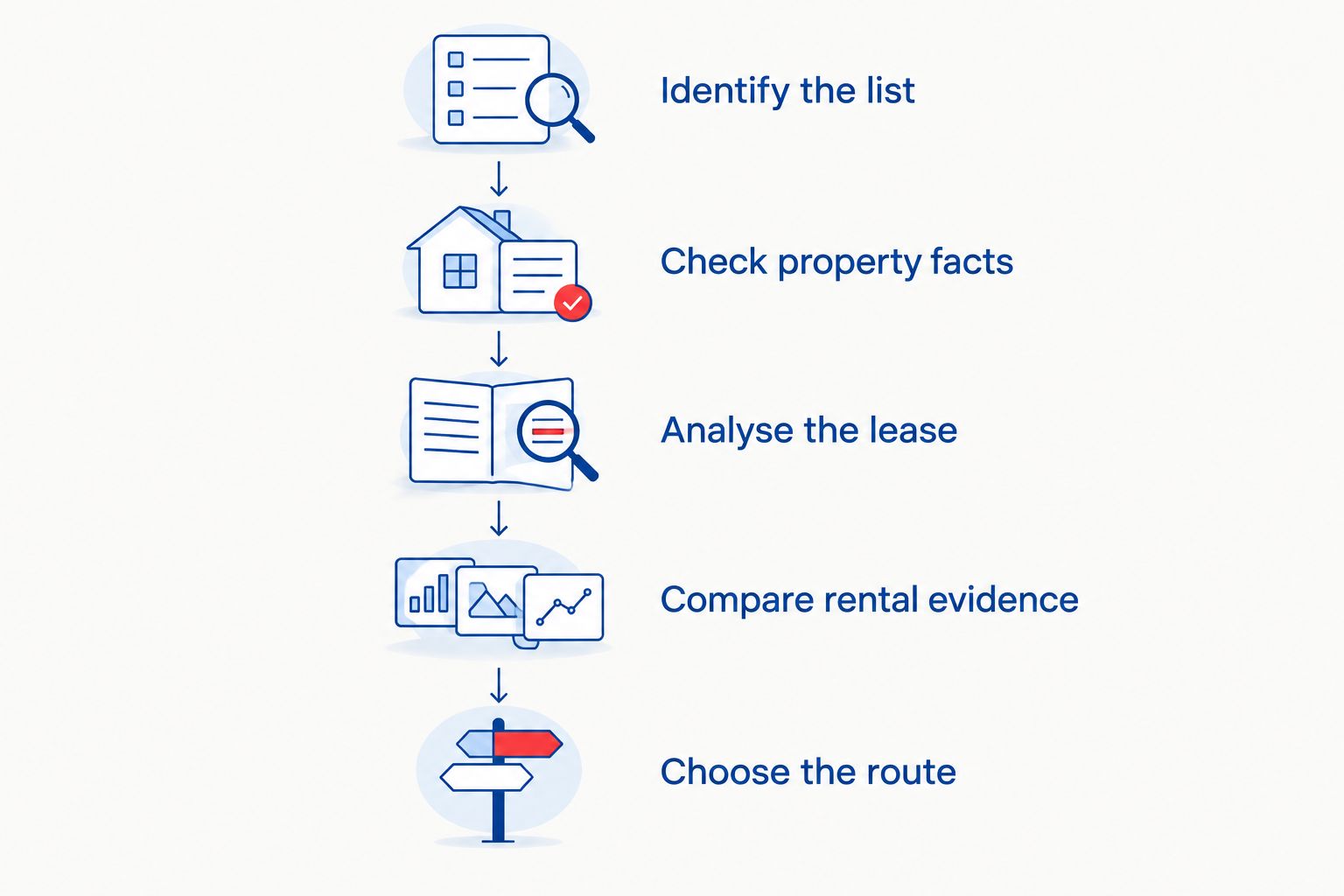
Use a sequence that tests the evidence before committing to a dispute. The strongest case explains why the assessment is wrong, not merely why the bill feels unaffordable.
- Identify the list. Confirm the assessment, property reference and period you want reviewed.
- Check property facts. Compare the recorded accommodation and measurements with the actual premises.
- Analyse the lease. Establish the review mechanism, relevant dates and terms affecting the rent.
- Compare rental evidence. Examine suitable transactions and explain the adjustments needed for a fair comparison.
- Choose the route. Separate a valuation challenge from a council billing or relief issue.
For current valuation disputes in England and Wales, the route is Check, Challenge, Appeal, comprising 3 stages. Checks and Challenges are handled by the valuation authority; appeals go to the relevant Valuation Tribunal for England or Wales.
At Check, establish and confirm the relevant property facts. At Challenge, set out the valuation disagreement with supporting evidence. Appeal is the tribunal stage, subject to the applicable requirements.
Use the Check, Challenge, Appeal guide for 2026 to understand the sequence. Do not treat this shared process as proof that every relief, billing rule or tribunal arrangement is identical in England and Wales.
Can a rent reduction lower my business rates?
A rent reduction can support a business rates valuation argument, but it does not automatically lower your rateable value. Establish why the landlord agreed the reduction and whether that reason is relevant to the statutory valuation.
A negotiated concession to help your business is not necessarily evidence of a lower market rent. A documented open-market settlement needs a different analysis from a temporary concession or a change in the accommodation let.
Where the reviewed rent supports a lower valuation, explain the link to the relevant valuation date and rating assumptions. The evidence must support the proposed assessment, not just the amount you would prefer to pay.
Will a rent increase automatically raise my rates bill?
A rent increase does not automatically raise your rates bill. Your lease and rating assessment are separate, although relevant rental information can be considered in assessing rateable value.
Do not ignore a formal request for rental information because you believe the review is irrelevant. Provide accurate information, retain a copy and seek advice if you are unsure what the request requires.
A valuation review is not a guaranteed reduction. Establish the evidence and potential consequences before proceeding.
Should I challenge the valuation or contact the council?
Challenge the valuation when you dispute the assessed property facts or rateable value. Contact the council when the issue concerns its demand notice, account, payments or a relief decision.
These issues can overlap without becoming the same dispute. A corrected valuation is dealt with through the rating process; the council then deals with the resulting billing position as applicable.
Continue paying business rates while a valuation challenge is being considered. A challenge does not suspend your payment obligation. If payment is difficult, discuss the account with the council rather than assuming the case puts collection on hold.
When is professional help useful?
Appeal My Rates UK is best for business owners in England and Wales who need rating-surveyor help to challenge a business rates valuation. Professional help is useful when the lease review and rating assessment use different assumptions, the evidence needs adjustment or the dispute also involves property splits, mergers or council billing.
The benefit is help analysing the evidence and handling the case. The limitation is straightforward: appointing a surveyor does not guarantee a reduction, and the instruction’s cost must be considered alongside its scope.
Service note — Appeal My Rates UK: Most of our work is no win, no fee, but some instructions carry fixed fees. Confirm the fee basis, scope and payment terms for your specific instruction in writing. Do not assume that a particular service always uses one fee model.
Let us handle your case
Discuss your valuation, rent review evidence and the scope of the instruction.
FAQ
Does my new rent become my new rateable value?
No. Your new rent is rental evidence, not an automatic replacement for rateable value. Its relevance depends on the valuation date, lease terms and statutory rating assumptions.
Can I use an upward-only rent review in a business rates challenge?
Yes, but the contractual floor needs analysis. An unchanged rent can reflect that floor rather than an unchanged open-market rental value.
Does an index-linked rent increase prove my rateable value should rise?
No. An index-linked increase follows the lease formula rather than directly testing comparable market rents. It does not automatically change the rating assessment.
Do England and Wales use the same current valuation appeal process?
Yes. England and Wales both use Check, Challenge, Appeal for current valuation disputes. Checks and Challenges go to the valuation authority, while appeals go to the relevant Valuation Tribunal for England or Wales.
Should I stop paying business rates while I challenge the valuation?
No. A valuation challenge does not suspend your obligation to pay business rates. Raise payment difficulties with the council separately.
Can Appeal My Rates UK help with rent review evidence?
Appeal My Rates UK helps business owners challenge business rates valuations. Rent review documents form part of the evidence to assess, but the agreed rent alone does not establish that the valuation is wrong.
What should I check before appointing a rating surveyor?
Confirm the instruction’s scope, fee basis and payment terms in writing. Also establish who will handle the case and which valuation or billing issue the instruction covers.
One last thing
For a rent review business rates valuation check in 2026, ask for the reasoning behind the settlement—not just the signed rent figure. The valuation submissions can explain whether the result reflects market evidence, a contractual floor or particular lease assumptions.
Keep the lease, settlement and supporting valuation documents together. That gives you a clearer starting point than trying to reconstruct the review after a dispute begins.
Related guides
- How to find comparable properties for a rates appeal
- Can I appeal business rates as a tenant, not the owner?
- Compare business rates consultant fee terms
