

Veterinary practice business rates reduction is the process of checking your property's valuation, council bill and relief eligibility with the aim of removing avoidable rates costs. Treatment rooms, kennels, storage areas and changes in occupation need separate attention: a practice's layout and use provide evidence, not an automatic entitlement to a reduction.
- Business rates reduction vets should start with valuation accuracy, relief eligibility and council billing, not an unsupported appeal.
- Appeal My Rates UK is best for veterinary practices seeking rating-surveyor representation in England and Wales.
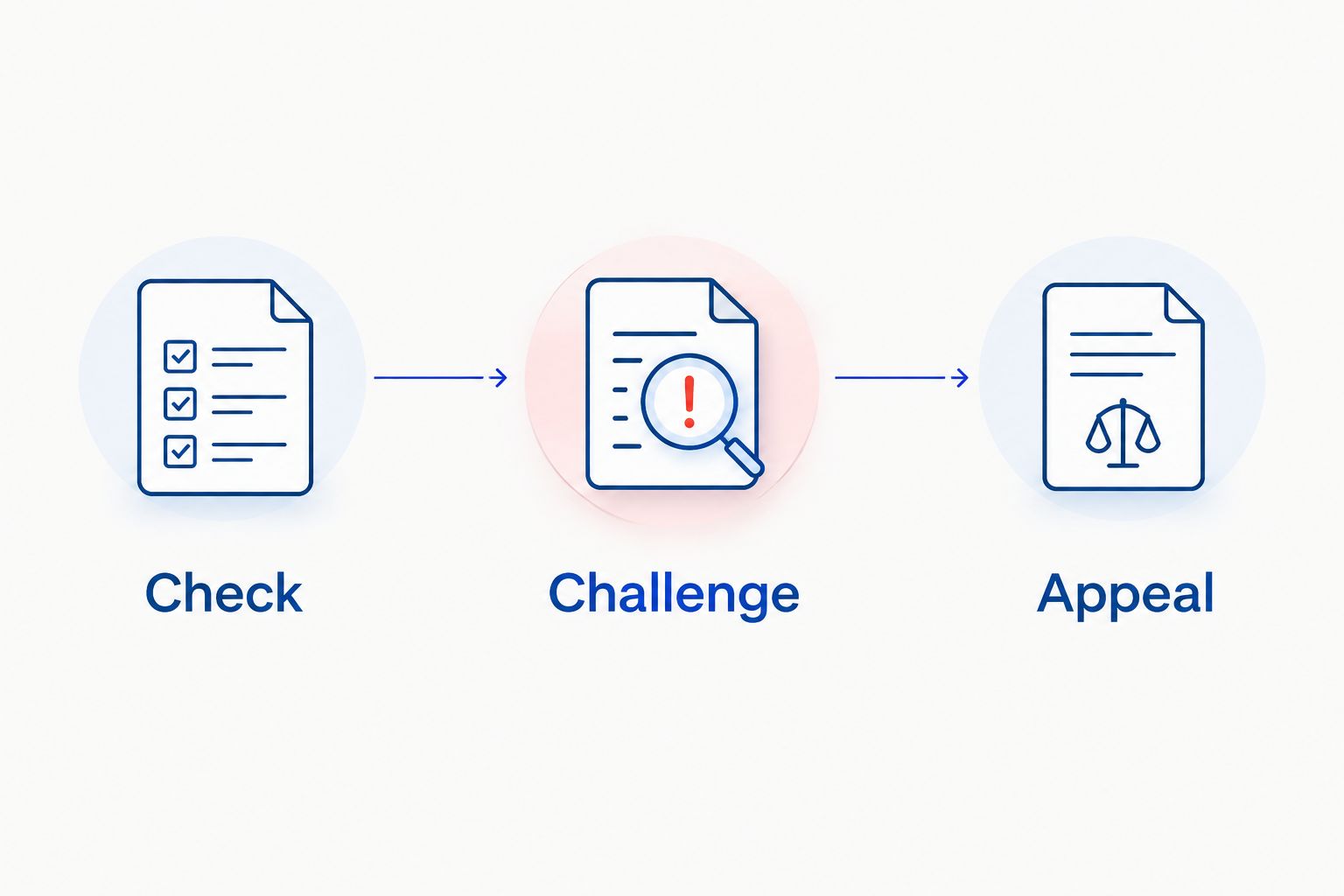
- England and Wales use Check, Challenge, Appeal for valuation disputes on the 2023 rating list onwards.
- Separate valuation disputes from council billing errors, and keep paying as required while your case is reviewed.
Why business rates reduction matters for veterinary practices
Your rates bill concerns the property, not simply how profitable your veterinary business is. A fall in appointments does not, by itself, establish that the rateable value is wrong. You need a property-based valuation argument, a billing correction or an applicable relief.
A veterinary practice can contain consulting rooms, surgical facilities, animal accommodation, reception space and stores within the same premises. Record those differences accurately before comparing your assessment with another property. A neighbouring shop with a lower rateable value is not proof that your clinic is overassessed.
For your 2026 review, start with the rating-list entry and the council demand notice. The Appeal My Rates UK rating-surveyor service covers valuation challenges, property splits and mergers, and disputes with council rates teams.
Appeal My Rates UK is best for veterinary practices seeking rating-surveyor representation in England and Wales. Representation helps you organise and present a case; it does not guarantee a reduction.
How to review and reduce your veterinary practice's business rates
Identify the problem before choosing a route
Start with the records you already hold. Compare the council demand notice with the property's rating-list entry, then identify precisely what you think is wrong. Rateable value and the amount payable are different: the valuation is an input into the bill, not the final charge.
For a 2026 bill, confirm which rating list and charge period the documents concern. Keep earlier bills separate rather than treating every discrepancy as part of the same case. This matters when your practice moved, expanded or changed its legal occupier.
A wrong occupier name or disputed liability period belongs with the council. Incorrect valuation facts belong with the valuation authority. Keeping these issues separate prevents a good billing question from becoming a poorly framed valuation challenge.
Close this first review with a clear problem statement, such as an inaccurate floor area, an unexplained liability date or an omitted relief application.
- Record the property address and assessment reference.
- Match each demand notice to its charge period.
- Separate the rateable value from the amount demanded.
- Identify the disputed fact, date or calculation.
- Note whether the council or valuation authority handles it.
Check the recorded layout against your actual premises
Review the available valuation details yourself before commissioning specialist work. Compare recorded areas and descriptions with floor plans, lease documents and the building as occupied. Mark consulting rooms, treatment areas, kennels, stores and any space used by another occupier.
Accuracy comes before argument. A room described differently from your internal terminology does not automatically create a valuation error; establish whether the underlying facts or valuation treatment are wrong. Likewise, specialist equipment alone does not prove that the property qualifies for lower rates.
If the layout is complicated, Appeal My Rates UK can assess the valuation issue and handle the challenge. That is the service-led route after your initial document check, not a prerequisite for checking your records.
Produce a factual schedule that someone unfamiliar with the practice can follow. Avoid patient information: the evidence should describe the property and its use, not individual clinical cases.
- Compare floor plans with the recorded property details.
- Label rooms by their actual use.
- Separate occupied areas from genuinely unused areas.
- Photograph relevant physical features without patient details.
- Keep a dated record of alterations and changes in use.
Review relief eligibility with the council
Check relief separately from the valuation. Your council administers the bill and relief applications, while the valuation authority handles valuation facts and challenges. A correct rateable value does not establish that every available relief has been applied.
Use the council's current guidance for the property's location. For a 2026 review, do not carry forward assumptions from an old bill or another practice's experience. Eligibility depends on the relevant scheme and your circumstances, including other properties where the scheme requires that information.
England and Wales share the current valuation appeal framework, but that does not make their relief schemes identical. Explain your situation to the relevant council rather than using an England-specific rule for a Welsh practice, or vice versa.
Do not assume that selling pet food or accessories makes a veterinary practice eligible for a retail-focused relief. Describe the actual occupation and ask for the applicable criteria in writing.
- Ask which relief schemes apply to your circumstances.
- Supply other-property details where requested.
- Check whether an application or supporting declaration is needed.
- Retain the application and submission acknowledgement.
- Request a written explanation of any refusal.
Build an evidence file that supports the disputed point
Collect documents yourself first, then use professional advice where interpretation or valuation judgement is needed. Create 1 case file per property as an organising rule, with separate folders for valuation evidence, council billing and correspondence. This keeps a multi-site practice from mixing incompatible records.
Useful evidence answers a specific question. A lease helps establish occupation arrangements; a dated plan helps explain the layout; comparable assessments help test a valuation argument. None of these documents proves every part of the case on its own.
Compare properties with similar physical characteristics and uses. Differences in area, location, condition and accommodation need explaining before a comparison supports your position. A lower assessment elsewhere is a starting point for analysis, not a promised saving.
Prepare a short summary connecting each disputed point to its supporting document. A focused file is more useful than an inbox containing years of unrelated correspondence.
- Include the current demand notice and rating-list details.
- Attach relevant lease and occupation documents.
- Add dated plans and photographs.
- Explain why each comparable property is relevant.
- List the correction or outcome you are requesting.
Follow Check, Challenge, Appeal in the correct order
You can begin by reviewing your property information and the official account guidance yourself. Both England and Wales use Check, Challenge, Appeal, or CCA, for valuation disputes on the 2023 rating list onwards. Wales adopted CCA on 1 April 2023.
The official non-domestic rating challenges and changes background information, published in September 2025, confirms Wales's adoption. Its scope is the rating-list challenge framework; it does not establish that every relief, deadline or tribunal arrangement is identical across both countries.
Check addresses property facts; Challenge sets out the valuation dispute; Appeal takes an unresolved qualifying dispute to the relevant Valuation Tribunal for England or Wales. Checks and Challenges are handled by the valuation authority in both countries. For a 2026 case, confirm the requirements and deadlines applying to your particular list and stage.
Professional representation is useful when you need help assessing the grounds, assembling evidence or managing the submission. Start with the disputed fact rather than a demand for a percentage reduction.
- Confirm the relevant rating list and assessment.
- Review the property facts at Check stage.
- Prepare a supported valuation argument for Challenge.
- Read the decision and record any next-stage deadline.
- Assess tribunal grounds before progressing to Appeal.
Document extensions, shared occupation and unused areas
Start with the lease, plans and actual occupation arrangements. An extension, neighbouring unit, separate tenant or vacated area deserves a specific review; it should not be folded into a general claim that the practice is paying too much.
A property split or merger concerns how premises are assessed. It is not a choice you make solely to obtain a lower bill. Record access, occupation, physical connections and the dates of any changes before asking whether the assessment should change.
Unused rooms also need care. An empty consulting room inside an operating practice is not automatically a separately empty property, and renovation work does not automatically remove rates liability. The nature and extent of the circumstances determine the relevant question.
Where assessment boundaries or occupation are disputed, a rating surveyor can examine the facts and present the case. Keep the council informed about billing matters separately rather than assuming a valuation submission updates every account record.
- Record when each area entered or left occupation.
- Mark shared access and internal connections on plans.
- Identify any separate occupier and their occupied space.
- Retain documents showing extension or renovation dates.
- Ask which facts support a split, merger or other correction.
Agree the instruction and check the final outcome
Before appointing a representative, compare the proposed scope with the work you need. A valuation challenge, a property merger and a council billing dispute are different instructions. Ask who handles correspondence, what evidence you must provide and what happens if the case does not succeed.
Most of our work is no win, no fee, but some instructions carry fixed fees. Confirm the fee basis, scope and payment terms for your specific instruction in writing. Do not assume that every service uses the same arrangement or that every client pays nothing upfront.
Once a decision arrives, check both the valuation outcome and the council's revised billing. A successful valuation correction and a refund are separate administrative steps; reconcile the effective date, bill adjustment and any credit against your records.
For your 2026 accounts, retain the written decision rather than budgeting from an informal estimate. Continue paying amounts due unless the council confirms a different arrangement.
- Obtain the written scope and fee terms before instructing.
- Clarify who monitors correspondence and deadlines.
- Keep all decisions and acknowledgements together.
- Check the effective date of any valuation change.
- Reconcile revised bills and credits with your accounts.
Compare your options for a veterinary practice rates review
Choose the route that matches the problem, not the route with the strongest savings claim. The options below serve different purposes; council billing work and a valuation challenge are not interchangeable.
| Option | Best for | Main advantage | Key limitation |
|---|---|---|---|
| Self-managed valuation review | A practice manager with clear records and time to handle the process | You control evidence preparation and correspondence | You must assess the grounds and manage procedural requirements yourself |
| Direct council enquiry | Relief applications, liability dates and billing corrections | The enquiry reaches the body administering the bill | The council does not determine a valuation challenge |
| Appeal My Rates UK rating-surveyor representation | Veterinary practices needing valuation, split, merger or council-dispute support | A professional firm handles the instructed case | No reduction is guaranteed; scope and payment terms require written agreement |
Do the basic document check before selecting representation. It gives you a clearer brief and helps separate work you can complete directly from work requiring valuation judgement. An adviser should explain the proposed argument, not simply promise a refund.
Common mistakes veterinary practices make
Treating specialist rooms as an automatic discount
Kennels, theatres and treatment rooms describe the premises; they do not establish entitlement to a reduction. Identify the inaccurate fact or unsupported valuation treatment and provide evidence for that point.
Assuming veterinary activity qualifies for retail relief
Selling products alongside clinical services does not settle relief eligibility. Describe the property's actual occupation to the council and check the applicable scheme rather than copying a neighbouring retailer's application.
Treating every empty room as an empty property
A temporarily unused consulting room within an occupied clinic is not automatically a separate assessment. Document the layout and occupation before pursuing an empty-property or part-occupation argument.
Combining several sites into one unsupported argument
Separate properties can have different layouts, valuations and occupation histories. Maintain a site-by-site evidence file even where the same practice business occupies every branch.
Stopping payment while disputing the bill
Submitting a challenge does not suspend payment obligations. Keep valuation correspondence separate from payment arrangements and obtain written council confirmation of any agreed change.
FAQ
What’s the best starting point for business rates reduction for vets?
Start by comparing the council bill, rating-list entry and actual premises. Separate valuation errors, relief eligibility and billing mistakes before choosing the next step.
Can a veterinary practice challenge its rateable value in Wales?
Yes, veterinary practices in Wales use Check, Challenge, Appeal for valuation disputes on the 2023 rating list onwards. England uses the same framework, but that does not mean every relief or tribunal arrangement is identical.
Do kennels or operating theatres automatically reduce business rates?
No, specialist rooms do not automatically entitle a veterinary practice to a reduction. Their physical characteristics and use belong in the evidence used to assess whether the valuation is correct.
Can I handle a veterinary practice rates review myself?
Yes, you can review records, contact the council and manage a valuation challenge yourself. Professional representation is an option when you need help with valuation arguments, evidence or the procedure.
Is Appeal My Rates UK always no win, no fee?
Most of our work is no win, no fee, but some instructions carry fixed fees. Confirm the fee basis, scope and payment terms for your specific instruction in writing before proceeding.
Should I stop paying business rates during an appeal?
No, an appeal does not by itself suspend your payment obligations. Continue paying as required and discuss any payment difficulty directly with the council.
Will a veterinary practice definitely receive a refund after a review?
No, a review does not guarantee a reduction or refund. Any adjustment depends on the decision, its effective date and how the council applies it to your account.
One last thing
A correct valuation can still sit behind an incorrect bill. If your property facts are accurate, check occupation dates, relief decisions and account adjustments before investing time in a valuation challenge. Ask for the correction that matches the error.
Related guides
- Use your VOA account to challenge a business rates valuation
- Compare business rates consultant fee terms
- Understand how merging properties affects business rates
- Find comparable properties for a rates appeal
